Seeing clearly through the eyes of Eszter Debreczeni, HR lead for Microsoft
Posted by Lee-Anne Ragan | Filed under Diversity & culture, Training & development

Eszter Debreczeni is Human Resources lead for Central and Eastern Europe, Microsoft. I met her recently at the WIN conference in Paris, where inspired by Life Lenses™ a self-assessment designed to help us identify how we see the world, she spoke to me about her ideas on seeing clearly.
Clarity of vision is key. Key to knowing ourselves, others and our world.
Come step into the world through Eszter’s eyes and see how she sees clearly.

Tags: assessment, eszter debreczeni, life lenses, perspective, seeing clearly, self-assessment
3 ways to deal with participant hackers (like a slacker but worse) or ‘What I learned from having our website hacked’
Posted by Lee-Anne Ragan | Filed under Conflict resolution, Training & development

You know your day is not going to go well when it starts off with a phone call from a client saying:“Uh, er, is your website supposed to have a picture of people with guns on it?”
Turns out our website was hacked, which, apologies to regular readers, is why there was no blog post on Friday. Instead of our regular homepage readers were ‘treated’ to a black background with a picture of people in green pointing guns at the reader. Nice. Not.
(And no, the above picture isn’t the image the hacker used. I didn’t want to give the hacker the privilege of appearing on my blog.)
Because you, my dear reader, are never far from my mind, I wondered how I could turn this frankly incredibly annoying situation, into a blog post. So here goes, 3 ways to deal with participant hackers.
The dictionary defines a computer hacker as ‘someone who uses computers to gain unauthorized access to data’. I have a more decisive description. A hacker is someone with far too much time on their hands, who has the morals of a toilet bowl, who chooses to use their powers to make other people’s lives a temporary mess.
A hacker participant then is someone in your training workshop who, despite your best efforts, despite your setting the best laid sumptuous smorgasbord of learning opportunities, chooses not only to disengage but tries to take the whole group with them and show you up in the process.
A hacker participant is different from a slacker participant. A slacker is someone who’s not into the learning but who’s not disruptive either. A hacker participant on the other hand is truly disruptive to the group and can suck the learning out of a workshop like a lemon press on a hot sizzling day.
Ever had one hacker participant? In my decades of training experience I’ve had a few and I always find them fascinating, like a rare breed who’s just been discovered.
Here’s how to recognize when you’ve got such a specimen in your workshop:
- they talk over you and everyone else
- they’re rude and sometimes even obnoxious
- they make everyone in the room uncomfortable
- they’re a bully
Here’s what to do if you recognize said specimen in one of your groups – try and figure out what their motivation is:
- do they think they’ve nothing to learn from you and the group?
- do they not like you?
- are they there against their will (only attending because the boss said so)?
- are they actually insecure but trying to cover it up by false bravado?
Finding out what’s motivating them can help with figuring out how to proceed.
My overall guideline is to match force with force. That is, if they are brash and loud then my reactions will tend to be on the bigger, brasher side. If they are quietly sucking all the enjoyment and energy from the room, then my reaction will tend to also be on the quieter side.
With that in mind here are three tips for handling hacker training participants … because handle them you must. The group is looking to you for action. When one participant is negatively affecting the whole group standing idly by is NOT an option.
- Stand close to the hacker and use bigger body language yourself. Stand with your feet further apart and put your hands on your hips from time to time. It’s a rare participant that will keep making rude comments when the trainer is standing close to them.
- Example: I was leading a training workshop with a high powered group of executives and one participant kept cracking rude jokes in an attempt to garner attention and make the workshop go off track. By standing behind him (while he was seated) and continuing to teach, it didn’t long at all for him to shut down.
- Take them aside at break and speak with them. You just never know what’s up in the life of a hacker and sometimes a gentle nudge can get them back on track or at least neutral enough that they’re not affecting the whole group. Share the responsibility for learning with them – ask them what they need to make the experience a positive one.
- Example: I was teaching a workshop to a large group of people and noticed that one woman wasn’t participating at all. I sat down with her and quietly asked her some questions, including what I could do to make the experience better for her. She was one unhappy person. Nothing was right, nothing could be right and everything was garbage. Okay, fair enough. While I really wanted to say ‘why are you here, how come you don’t just leave?’, I thanked her for her input and went back to the overall group. Sometimes you can’t make things right but it’s good to show you’re concerned and make an effort.
- If they’re really obnoxious, call them out in front of the group. If a participant is being rude to you in front of the whole group then more drastic action is called for. I match power with power. If someone’s acting big and puffy then I do the same.
-
- Example: I once did a workshop starting at 4am (yes 4am) for shift workers in a high tech industry. I said hello to a fellow as he walked in and asked if he’d just been exercising (as he was wearing shorts). With his back to me he made a disparaging comment about my age. Matching force with force, and knowing all eyes were on me and that this was the first of a series of workshops and if I didn’t do something that’s all anyone would talk about, I said something he wasn’t expecting in a loud voice so everyone could hear ‘I’m so glad you mentioned my age, I just turned 40 and it’s great. The only thing is I’m not getting gray hair fast enough. Love gray hair, wish I had more.’ I saw him literally stop in his tracks, pause and then continue on to his seat. He wasn’t rude after that. While I can’t claim to have just turned 40 anymore, I can claim the technique worked like a hot damn.
So hacker, whoever you are, thanks for the opportunity to look at hacker training participants as the muse for this blog post.
If you have any techniques for dealing with hacker participants I would love to hear them. Bring ’em on.
Tags: group development, group roles, hacked, hacking, learning & development, training particpants
The fine art of balance
Posted by Lee-Anne Ragan | Filed under Communication, Training & development

The gorgeous video clip below came to me via Dyana Valentine. Other than wondering how the artist can manage to spend so much time upside down while looking so effortless and graceful, it’s got me thinking about balance.
As a learning and development specialist I think a vastly overlooked aspect of training is balance. We all have ways we prefer to learn and yet, if we’re not careful, that’s exclusively how we can end up training. We can unwittingly create and facilitate unbalanced trainings that aren’t accessible nor inclusive.
If I’m in a workshop and the trainer says ‘don’t worry about taking notes, I’ve written everything down for you in the handouts which I’ll give you later on’ I’m immediately frustrated and my lizard brain kicks in. Why? Because if I have to only rely on listening, that info ain’t going in my brain easily. I need to write, to doodle, to make lists, to create links, make charts.
Ultimately creating trainings that are engaging and stick means striking a balance.
Striking a balance between:
– Carrot Life Lenses™ (who want details, details, details) and Mountain Life Lenses™ (forget the details, just give me the big picture)
– Stop Life Lenses™ (who want to pause, reflect, plan and think) and Go Life Lenses™ (who are geared for action, who want to dive in and try)
– Journey Life Lenses™ (whose focus is on the path, where we’re headed isn’t so important) and Destination Life Lenses™ (whose focus is checking things off, getting things done)
– Heart Life Lenses™ (who rely on their intuition and gut to learn) and Head Life Lenses™ (give me just the facts ma’am)
What kind of trainer are you? Which lenses come easily and naturally to you when you are designing and delivering training? Which are more of a mysterious black hole? And most importantly, what implications does this have for your training?
Tags: artur, balance, carrot life lenses, destination life lenses, go life lenses, head life lenses, heart life lenses, journey life lenses, learning & development, life lenses, mimworld, mountain life lenses, perspective, stop life lenses
Seeing clearly in the eyes of Maggy Barankitse, Founder Maison Shalom
Posted by Lee-Anne Ragan | Filed under Communication, Training & development

There are those who walk among us, whose mere presence is enough to command respect, to cause one’s eyeballs to pivot forward and focus with intensity, to straighten one’s shoulders, lift one’s head and vow to do better, to be better.
Marguerite ‘Maggy’ Barankitse is one such person.
Maggy, pictured above with myself, is founder of Maison Shalom (House of Peace). After witnessing the slaughter of her colleagues at a mission in her home country of Burundi during the Civil War between the Hutu and Tutsi tribes, which lasted more than a decade and where more than 300,000 people were murdered, Maggy was not done.
She did not give up. She did not loose hope. She did not loose faith in humanity.
She did help an orphaned child whose parents had perished. She did help another one. And another. She did create self-employment programs, where the youth own their own businesses. She did create inter-ethnic family housing. She did take in former child soldiers. Believing that children deserve more than mere survival she did build a cinema and a pool.
She has now helped more than 30,000 children.
In Burundi, a small African country which the World Bank considers to be the poorest in the world and where the majority of people live on less than $1 per day, she says “I know that evil will never take the last word. Never. Never.”
Here she is, in her own words, describing what it takes to see clearly. In essence we need a vision, we need to be clear about what we wish for, where we’re headed and what we want to realize.
Maggy’s vision has enabled her to achieve remarkable things. How does your vision enable or hinder your ability to design and facilitate remarkable trainings?
Life Lenses™, a self-assessment, is designed to help you see clearly. I hope it does just that.
Tags: house of peace, life lenses, Maggy Barankitse, Maguerite Barankitse, Maison Shalom, perspective, seeing clearly, self-assessment, WIN conference
Great trainers are great adapters
Posted by Lee-Anne Ragan | Filed under Change management & wellness, Training & development

Tags: adaptation, adapting, change management, learning & development, mimic octopus, training & development
Creativity lies everwhere, even in how you store your business cards
Posted by Lee-Anne Ragan | Filed under Creativity & innovation, Training & development, Travel
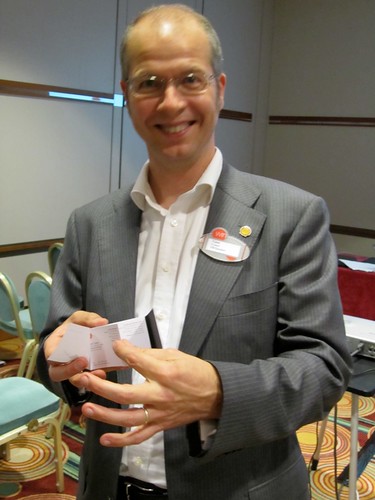
Meet Yann Cramer, editor at InnovToday and Global Technology Manager at Shell. I met Yann at the W.I.N. conference in Paris where we were both speakers. I thoroughly enjoyed his workshop on creativity and saw him walk his talk when we exchanged business cards.
More about that in a minute.
Creativity, ‘the use of the imagination or original ideas, especially in the production of an artistic work’ and innovation, the act of implementing creative ideas, are both highly sought after skills no matter if you’re a learning and development specialist in a large corporate company or a solo-entrepreneur trainer.
Training workshops that are creative are much more likely to engage participants and increase retention.
In the hustle and bustle that we call life, coming up with original ideas and implementing them can seem like scaling a Catherine Destivelle size mountain. It doesn’t have to be that way however.
While creativity can arrive in a flourish with the accompanying whoosh of a super hero cape, it can also come in a whisper, with small ideas that can make us stop and think. Speaking of which ….
 Have you ever, in your effort to exchange business cards with someone, dropped your stack on the ground and had them spread out like an errant fan?
Enter Yann’s business cards. 
Who says business cards have to be single and detached? What would happen if you combined the ease of a bound notepad with the necessity of business cards. Take a look.
Will this thinking change the world? Maybe not. But constantly exercising our creative muscles sure will.
Tags: catherine destivelle, creativity, innovation, WIN conference, yann cramer
“We are born with the capacity to hear, we must learn to listen” Miha Pogacnik
Posted by Lee-Anne Ragan | Filed under Communication, Creativity & innovation, Training & development, Travel

His arm flew, directing the bow in a wild and frenetic dance with the strings, while his chin hung onto the base of the violin for dear life. His hair looked like a bowl of fine spaghetti flying off in one direction, only to be pulled back in another with the rhythmic sway of his body.
Interrupting the music notes he launched into the air were his enthusiastic musings about the language of music, which he described with equally enthusiastic thrusts of felts on the page.
It felt as though this exuberant man had sucked the air right out of the room with his energy. We all held our breath as result.
Welcome to a workshop given at the W.I.N. conference in Paris recently by Miha Pogacnik, the Cultural Ambassador & Founder of the Institute for the Development of Intercultural Relations Through the Arts.
The most memorable statement he made for me was “we are born with the capacity to hear, we must learn to listen.” Apropos as someone who has carved out an international career based on giving the gift of music and encouraging people to truly hear it.
And us trainers? What do we need to listen for when we’re practicing our art and craft?
In between the syllables, in between breaths and breaks there is much fuel for training and development … if only we listen.
Tags: creativity, hearing, Institute for the development of Intercultural Relations through the Arts, learning, listening, Miha Pogacnik, training & development, WIN conference
What it takes to see clearly in Senator & Minister of State Ms. Malahoo’s view
Posted by Lee-Anne Ragan | Filed under Business & organizational development, Training & development, Travel

I recently had the honour of hearing Ms. Malahoo, Senator and Minister of State for Jamaica, speak at the W.I.N. conference in Paris. She was dynamic, engaging and articulate. She graciously agreed to be videotaped, speaking about what it takes in her view to see clearly.
We’re all inundated with things to do, places to be and priorities to juggle. At times our perspective can be skewed as a result. Clarity is a necessity for living a life that’s true to oneself.
Here are some tips on how to do that from Ms. Malahoo’s view. For more tips, see the Life Lenses self-assessment.
Tags: life lenses, Marlene Malahoo, perspective, seeing clearly
Musty learning made new, Amsterdam style
Posted by Lee-Anne Ragan | Filed under Creativity & innovation, Training & development, Travel

I remember whiling away long, hot summer days as a child curled up in a corner of my local library. Feet tucked under me, I’d fold myself into a corner, head buried in a story. The musty smell of books and the dull, gray walls would be replaced by whatever adventure my mind had taken me to via the pages of what I was reading such as solving mysteries with Nancy Drew or dreaming up fanciful, new art projects.
Fast forward to a few weeks ago when I found myself in an entirely different sort of library, where my good friend and colleague, Gerd Junne, had taken me in Amsterdam. The airy, open space beckoned imaginations to bloom and flourish. Even the computer screens gave reason to pause (and not just because they were Macs). Each computer had its own distinctive screen saver.
The one above says ‘helpless’.
The one below says ‘lie’ and the one below that, ‘bored’ as if to draw a line in the sand and test you. Could you possibly be bored in such a place?


Absorb, grow, weave, inhale …. learning comes in all places, in all forms.
Tags: amsterdam, gerd junne, imagination, learning, library
What the canals of Amsterdam have to teach us trainers about self-care
Posted by Lee-Anne Ragan | Filed under Conflict resolution, Training & development, Travel

Recently I spent some time in Amsterdam with my friend and colleague Gert Junne of the University of Amsterdam and Network University. As we dialogued for hours about our mutual work, sharing resources and ideas for collaboration we drove through the country side exploring.
The picture above shows the North Sea on the left. The land on the right is actually lower than the sea.
As much of Amsterdam is below sea level pumps are vital to keeping the land from flooding especially when it rains. You can see part of a pump station in the picture below. Without these pumps life would be changed drastically, requiring more boats than bikes to get around.
 Which made me think of maintaining equilibrium.
Which made me think of equilibrium for the self- the basics of self-care for trainers. We as learning and development specialists spend so much time focusing on our participants, pumping out ideas and innovative ways to teach, that we can sometimes forget to take care of ourselves.
When I’m teaching SME’s (subject matter experts) how to design and teach engaging workshops, part of what we cover is how to care for ourselves. What I’ve noticed is that strategies are highly dependent upon the individual.
Some trainers for example, who are extroverts by nature, will seek out participants at break and lunch. Others need quiet to regroup, plan and rest.
Here are some recommendations to keep your pumps open and flowing so to speak.
Before a training spend some time figuring out what self-care means to you and plan (and pack) accordingly.
- Bring an IPod to plug into on break for some soothing tunes.
- If you’re anticipating a particularly stressful training (perhaps attendees are there not by choice or the environment is highly conflictual) bring a scent that relaxes you (for me it’s lavender).
- If your break is extended do something active – go for a run, do some stretching etc.
- Bring a journal to write in.
- Make sure you’ll have access to food that is good for you during breaks.
- If you’re doing an international training, take jet lag into account. I never travel internationally without my Jet Lag TM pills- they make a huge difference in my ability to settle into the local time zone faster.
During a training:
- Figure out what you’ll do on breaks – do you need some time to yourself to regroup and rest up? Or do you prefer to spend that time getting energized by touching base with your participants?
- Experiential education is good not only for increasing retention of training material but also for the trainer. As your participants are busily engaged in an activity, take a moment and take a breath.
After a training:
- Figure out what worked and what didn’t. What can you change up for next time?
- Create a self-care kit that you can pop in with your training supplies bag each time you do a workshop. Easy peasy.
Gerd explained how reflections off the water in the many canals in Amsterdam affects the sky light in unusual ways. This light quality historically drew master painters of old to Amsterdam like bees to honey. I have a sense that the painters felt comfortable surrounded by such beauty.
Training is a form of art. Surround yourself with your form of beauty, take care of yourself and you and your participants will be better for it.
Tags: gerd junne, learning & development, network university, self-care, subject matter experts, university of amsterdam