How you get kids to wash their hands can tell you a lot about effecting change
Posted by Lee-Anne Ragan | Filed under Change management & wellness, Training & development

Washing hands prevents sickness, prevents spreading disease. Washing your hands properly can reduce your chances of death, yes death, by up to 35%.
Nothing new there.
Smoking kills. The World Health Organization says that 4.2 million people died prematurely in 2000 from smoking. Smoking stinks, it’s expensive and (as a non-smoker I can only imagine) the inconvenience of having to eek out a place where you’re actually allowed to smoke has to be grueling. (insert caveat here: this is from a mostly North American perspective where there are mighty few places folks can freely smoke. I acknowledge it’s very different in other parts of the world.)
Nothing new there either.
So why then do so many people smoke? And why do so many people not wash their hands properly?
It’s not just about information, facts and theories (apologies to Head Life Lenses™) but rather about social influences, emotions and values (a tip of the hat to Heart Life Lenses™).
As learning and development specialists, recognizing these influences is key to developing and delivering engaging workshops that are relevant and memorable. And key to effecting change, because after all, as a trainer you are change maker. The status quo isn’t an option.
Here’s a look at effecting change through getting kids to wash their hands (6:20 min) done by Hyrum Grenny, son of guru Joseph Grenny.
(This is one of the resources from the recent Rock.Paper.Scissors e-newsletter interviewing global change agent Sara Mitaru.)

Tags: head life lens, heart life lens, hyrum grenny, josephy grenny, sara mitaru
Learning about change & the power of music to rock the world from United Nations ‘Messenger of Truth’ Sara Mitaru©
Posted by Lee-Anne Ragan | Filed under Change management & wellness, Social Responsibility
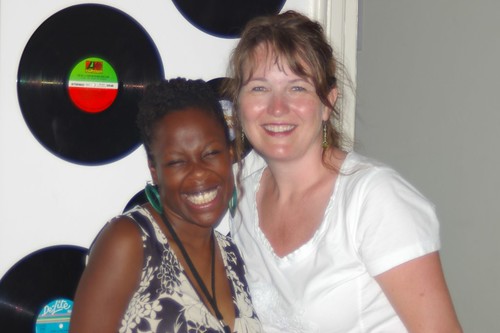
Imagine being able to write “Messenger of Truth” as a job title on your CV. That’s what the incomparable Sara Mitaru can claim.
- to inform youth living in slums and inner cities of the Millennium Development Goals through the songs and performances of socially committed Hip-Hop artists singing and rapping in different languages worldwide;
- to empower youth organizations worldwide by providing platforms where their voices can be heard and to help legitimize their participation in decisions that affect their livelihoods and finally;
- to support projects worldwide demonstrating how youth organizations have been able to solve critical social, economic and environmental problems.
- the medium is the message
- the power of women & storytelling
- effecting social change
See the video of my interview with her below.
Tags: messenger of truth, sara mitaru, social change, storytelling, united nations
What’s your theory of change? Evolution or Revolution?
Posted by Lee-Anne Ragan | Filed under Change management & wellness

- evolution: change happens best as a slow, gradual process, like a river washing over and eventually shaping the rocks that line its bed
- revolution: change happens best when it’s in your face, abrupt, obvious and stark
- or are you somewhere in the middle of the two?
Tags: alicia kritsonsis, change, change theory, effecting change, learning & development, sara mitaru
10 ways how to wrap a training (and a cat)
Posted by Lee-Anne Ragan | Filed under Communication, Training & development

Creative Commons licensed: gfpeck
It’s the end of the week and all good things must come to an end, especially trainings.
The primacy and recency effect in training tells us that participants tend to remember what happens first and last, hence the need for a good ending.
How do you end your trainings?
Here’s a checklist of things to keep in mind:
- ending a training is more than saying ‘we’re done, go home’
- ending a training is not the time to open things up to questions – encouraging questions should happen throughout the process
- ending a training is one of the most critical parts of the workshop – just like the introduction and the body
- pay attention to how you close the process – what can you do to transition the individual participants out of the group, deal with any emotions or relevant issues that came up?
- pay attention to how you close the content – what can you do to help the participants review and carry their learning forward?
- some groups need a thorough focus on process and little content closing; other groups will be more 50/50 and yet others will be mostly content focused – which is yours?
- include logistical things that need to be covered (e.g. sending follow-up resources)
- include evaluation – ideally you’ll have been doing this throughout the process (depending on how long the workshop is) but often it’s good to get some final feedback in a way that makes sense for your workshop
- encourage communication – share your social media contact information – email, Twitter handle, Facebook, LinkedIn (whichever are appropriate for you)
- encourage sharing resources – I rarely end a workshop without showing my website, blog, newsletter resources, book lists, delicious account (social bookmarking site that lists my online resources)
That’s a wrap. Make it good, make it sticky.
And speaking of wrapping, here’s another way to do it (tongue firmly in cheek) … (since I first saw this video they’ve added an obnoxious 15 second advertisement; feel free to ignore it – the real video is worth waiting for).
Tags: content, logistics, process, recency effect
I’m listening … to you
Posted by Lee-Anne Ragan | Filed under Human resources
It’s been just over a year since my first blog post (My first African nocturnal visitor) and I thought I’d offer an ear up to hear your thoughts about my blog.
What do you like? Not like? Want more of? Want less of? I invite you to take 5 minutes (or less) for 5 questions and fill in the survey.
Know that I really appreciate your feedback and thank you in advance for sharing it. As a gesture of thanks, by filling in the survey, you’ll be entered to win a free Life Lenses™ assessment.
I can’t wait to hear your feedback. Know that I’m listening, I’m truly listening. I’m paying attention. Truly.
Unlike the folks below…
Tags: customer service, feedback, life lenses, survey
Ingunn Aursunes’s views on seeing clearly
Posted by Lee-Anne Ragan | Filed under Communication, Training & development

Ingunn Aursunes of Quantum Leap Consulting in Norway, talks about how to see clearly in the clip I interviewed her for below.
She speaks eloquently about ‘listening for other things than what our ears can capture.’
Sounds like a smart Heart Life Lens™ to me.
Tags: Ingunn Aursunes, life lenses, perspective, quantum leap consulting, seeing clearly, self-assessment, WIN conference
Not paying attention as a trainer can make you take an unwanted bath
Posted by Lee-Anne Ragan | Filed under Human resources, Training & development

I once took a university course, early Friday mornings at 8:30 am, with only 3 others in the class. There was another painful aspect to it other than the early hour. The professor lectured from notes so old they were yellowed. Plus his monotonous tone matched the static nature of his notes.
Mother of mertle take me now.
Talk about demoralizing. Talk about not being able to hide my boredom (did I mention there were only 3 others in the class?).
Learning and development specialists take on a great responsibility when we sign on to create and deliver engaging workshops. People carve out precious time and pony up hard earned bucks to be there. Part of living up to our responsibility is paying attention. Paying attention to those who:
- are engaged and eager … and those who aren’t
- are participating … and those who aren’t
- are sharing the space … and those who aren’t
- have big exclamation marks of interest above their heads … and those who have big, quivering question marks
- love what you’re doing … and those who don’t
Being a great learning and development specialist also means paying attention to:
- the big picture (Mountain Life Lens™) and the details (Carrot Life Lens™)
- the process (Journey Life Lens™) and the content (Destination Life Lens™)
Paying attention is a key attribute to a great trainer.
Not paying attention means being on automatic pilot, like the fellows below. If we don’t pay careful attention while we’re training we may end up taking a bath.
Tags: attention, learning & development, life lenses, perspective, training & development
The view from Dolores Umbridge (Harry Potter) on a bad, very bad day
Posted by Lee-Anne Ragan | Filed under Human resources, Training & development

The word’s aflutter with the release of the new Harry Potter movie, which made my kids take the opportunity to watch a previous version, specifically the Order of the Phoenix. We were all snuggled up in bed watching when it occurred to me that the character Dolores Umbridge is a great example of a worldview, specifically a view of an educator, gone very wrong.
Her perspective is all about:
- unquestioned authority
- top down approach
- “I’m the teacher and I know everything”
- “you’re the student and you know nothing” (and I’ll do everything in my power to put you in your place)
- use of coercion and force
It’s a Head Life Lens™ on a very bad day: paying attention to concrete, tangible things in the extreme with no sensitivity (her use of punishment is down right abusive)
It’s a Destination Life Lens™ on a very bad day: Delores is only concerned with pleasing the Ministry of Magic and getting the school in shape. She’ll do anything to achieve that goal. In her mind the end justifies the means.
It’s a Carrot Life Lens™ on a very bad day: attention to minuscule, unimportant details
It’s a Stop Life Lens™ on a very bad day: adherence to tradition for the sake of tradition, no willingness to try anything new
Check out the clip below to see her in action. If you’ve already had a trainer with this worldview you have my empathy. Whether or not you have, may you never have one again.
Tags: delores umbridge, harry potter, learning & development, life lenses, perspective, worldview
Seeing clearly through the eyes of Lydia Nakayenze
Posted by Lee-Anne Ragan | Filed under Communication, Diversity & culture, Travel

Lydia Nakayenze is as colourful in character as the outfit she’s wearing below. Originally from Uganda, she’s living and studying in Germany at the moment. I met her at the Women’s International Networking conference in Paris, where she spoke to me about her ideas on seeing clearly.
It’s easy for our vision to be cloudy. Realizing where you see with clarity and where you need polish helps.
Come see the world through Lydia’s eyes and hear what she thinks it takes to see clearly.
Tags: Lydia Nakayenze, perspective, seeing clearly, self-assessment, WIN conference
Where’s your rudder? Inspiration for training & development specialists
Posted by Lee-Anne Ragan | Filed under Creativity & innovation, Training & development, Travel

Regardless of whether you’re a landlocked lubber or a water born baby chances are you know where a boat rudder is. On the bottom of the boat. Right?
Not necessarily.
For a land crisscrossed with water (in fact 1/4 of it is below sea level), Holland knows a thing or two when it comes to getting around on the wet stuff. When my friend and colleague Gerd Junne took me about on a visit there, his natural gift for finding teaching moments led met to noticing what looks like a folded wing on the boat above.
Turns out the canals of Holland aren’t very deep, which makes having a traditional rudder on the bottom of a boat not work. The rudder would likely be torn right off as it scraped the bottom. The canals are wide however, which created the opportunity for literal lateral thinking.
Boats like the one above store their rudders on the side. When needed they are simply slipped down and into place. Voila. Problem solved.
Like training. Everywhere is a chance to learn. Every workshop is a chance to touch participant’s lives and welcome them into a world of learning.
There are always teachable moments.
In fact the best training and development comes from combining lived experience (participant’s own experience) with new information. It’s a form of praxis – a popular education technique where trainers cycle back and forth between theory and action. Theory and action. Theory and action. Theory and action.
Makes a nice mantra. Say it with me while floating your boat…
Tags: amsterdam, gerd junne, popular education, praxis, rudder