Theatre of the mind – Ted Williams & dancing with dichotomy
Posted by Lee-Anne Ragan | Filed under Change management & wellness, Conflict resolution

Theatre of the mind. That’s what Ted Williams, the homeless man who has become a Youtube sensation, calls radio.
That’s some perspective. Especially considering his background. As someone who has fought the demons of drugs and alcohol and who has made his home on the streets, his velvety voice is at odds with his appearance.
Dancing with dichotomy.
Theatre of the mind opens a plethora of opportunities, of ways to think about and chew over what the box is that sits on many of our counter tops. And what it’s for.
That’s what perspective does. It can open the door or slam it faster than you can say ‘happy new year’. Perspective can be broadening or limiting.
What’s your perspective on change? Something to be …
- suffered
- smothered
- sought after
What about conflict? Something to …
- be avoided at all costs
- provoke
- stabilize the situation
- effect social change
In working with hundreds of clients over the years, I’ve noticed that perspective is a powerful thing. Whether it be conflict, change or another topic, the theatre playing in our mind influences the roles we cast for ourselves and others.
What does your theatrical script say for the upcoming year? What role will you play? What stages will you grace? And which will you stay away from?

Tags: dancing with dichotomy, new year, perspective, ted williams, theatre of the mind
The results are in (again): the collated creativity E.S.C.A.P.E. assessment (where do you measure up?)
Posted by Lee-Anne Ragan | Filed under Creativity & innovation
 How creative are you? I wrote a blog post back in July because any and all humans can afford to be more creative (that includes us trainers). Creativity is the numero uno ingredient for success. Doing the same ol’ same ol’ doesn’t work anymore (not sure it worked ever).
The post included a short assessment for examining where your creative strengths lie and where you may be falling short. Folks continue to fill in the survey (120 in fact) so I thought you might like to see the updated results.
The good news? Creativity can be taught, so whether you need to dig deep into your DNA to find it or whether it’s riding in your veins skin deep take a look at the collated results of the 6 question assessment. (And if you haven’t yet taken the assessment simply click the link above and you’ll be taken there).
Each question on the assessment relates to an element of the E.S.C.A.P.E. model, I co-developed with the great Dolly Hopkins.
e = evoke
s = shades of gray
c = cobble
a = assumptions
p = praise and celebrate
e = engage
Here are the updated results in order.

If you know how to evoke or call your creativity out of hiding when you need it kudos, shake those pom poms. If you don’t know how to evoke your creativity, spend some time thinking about what sets the stage for your creativity to show its head. For example do you need a quiet environment, free of distractions or is a noisy, cacophonic environment more your taste?
 Shades of Gray or being able to look at things other than in a yes/no, black/white, either/or kind of way is a key component to ramping up creativity. Not being able to look at things in shades of gray is the biggest killer of idea generation, as in: that’ll never work, we’ve tried that before, that’s too expensive. If you need to work on finding your shades of gray then shoo the critic who’s whispering in your ear from your shoulder and let anything go for now, knowing that you’ll be back later to weigh the pros and cons.

Cobbling, or be able to put disparate things together to come up with something new, is another key element of creativity. An example is using the idea of a ball point pen to invent roll on deodorant. Who needs to invent the wheel – put things that have already been created together in a new way. If you need to work on your cobbling skills practice picking random words and creating a story for how they’re related e.g. what does a dessert hare have to do with a tape measure?

Respondents go against research findings which say that when something’s not working, we tend to simply repeat whatever we’ve been doing the same way, over and over (knocking our head against the wall in the vain hope that the wall will somehow move). In other words we can identify our assumptions and move on.
A critical skill here is recognizing when we’re making assumptions because assumptions will block our ability to ramp up our creativity. An example is a company, who in trying to reduce drinking and driving, asked themselves how can they could increase (yes increase) drinking and driving.
They turned the assumption on its head for a moment (that increasing drinking and driving would be a bad thing). This led to the invention of a machine that would simulate what your vision would be like after 1, 2, 3, etc drinks. The machines, installed in bars, were a hit.

More than a third of respondents didn’t have a way to praise and celebrate their creative accomplishments. Too busy moving onto the next goal me thinks. If we create a plan ahead of time though that’s a big motivating factor. Hint: it has to specifically celebrate creativity, not just completing the project, landing the account etc.
 Almost 80% of respondents go about a creative project haphazardly, which leads to the last principle which is engage. When it’s time for the petal to hit the metal research shows a plan is a good thing, it’s a launching pad for boosted creativity. So get a plan, any plan and go forth.
Tags: assessment, creativity assessment, Dolly Hopkins, escape
Time for audience participation (that means you): we see what we expect to see
Posted by Lee-Anne Ragan | Filed under Creativity & innovation, Diversity & culture

I love traveling by train so when I found myself on the platform in Amsterdam looking for the right platform I was like a kid looking forward to an ice cream cone on a hot summer’s day. (The fact that I was headed to Paris didn’t hurt either.)
Despite a well-organized system though I couldn’t find the right track. I asked someone to point me the way and he replied ‘there, look at the sign, it’s just over there’. I gazed up expectantly, only to be befuddled as I couldn’t see my train’s name on the sign he was pointing to. I asked again. He pointed again. I befuddled again. Finally a kind soul pointed me the right way and all was well but not before I had a good laugh at myself.
Time for audience participation. Listen to the 5 second clip below and figure out how you’d spell the word I’m saying.
How did you spell the word I mentioned in the clip?
I come from a part of the world where a major telecommunications firm is of the same name. So when the helpful guy told me to look for ‘tell-us’ I unwittingly looked for how the telecommunications company spells it, namely ‘telus’.
No wonder I couldn’t see what was posted on the sign right in front of my face. The train company, far from being spelled ‘telus’ and yet while it’s pronounced the same, is spelled ‘thalys’.
We see what we expect to see. Or as John Lubbock says, “What we see depends mainly on what we look for”.

Are you ready to see clearly? Check out www.life-lenses.com
Tags: John Lubbock, life lenses, perspective, telus, thalys, worldview
20 Awesomely Untranslatable Words from Around the World
Posted by Lee-Anne Ragan | Filed under Diversity & culture

Know what Toska means? How about Jayus? Jason White wrote an article about ’20 awesomely untranslatable worlds from around the world for Matador Abroad.
Toska and jayus are two of 20 untranslatable (or at least tough to translate) words from other languages.
Toska is a Russian word meaning “great spiritual anguish, often without any specific cause; a dull ache of the soul, a longing with nothing to long for, a sick pining, a vague restlessness, mental throes, yearning.” Lots of English words to describe one Russian word.
Jayus on the other hand is Indonesian for “a joke so poorly told and so unfunny that one cannot help but laugh”.
Language, when we’re on the same page and speaking from the same perspective, can be a bridge to understanding. When that bridge is very long and overarching however, one can’t see the other side. It can be shrouded in mystery and misunderstanding. Confusion results.
“What are you talking about?” “I don’t get it/her/him!” “That person is from another planet.” “They’re speaking English but they may as well be speaking Latin.”
For example, for people who communicate with emotion and rely on their intuition (Heart Life Lenses™) those who rely on logic and facts (Head Life Lenses™) can be completely baffled by them (and vice versa). Here’s a simple tip to get across the bridge:
If you’re a Heart Life Lens™ try using the word ‘think’ (even though it may feel odd), as in ‘What do you think is the best way to proceed?’
And if you’re a Head Life Lens™ try using the word ‘feel’ (even though you may think it’s odd), as in ‘What do you feel is the best way to proceed?’
In my experience substituting think for feel or feel for think can make a big difference.
Understanding another’s perspective helps get across the bridge to understanding. Figure out your perspective (including where your blind spots are) and you’ll go far.
Tags: facts, head life lens, heart life lens, intuition, jason white, life lenses, matador abroad, perspective
Ditching dichotomous thinking: blending old & new
Posted by Lee-Anne Ragan | Filed under Business & organizational development, Change management & wellness

Dichotomous thinking gets us into trouble.
- old / new
- love / hate
- either / or
- yes / no
- black / white
- right / wrong
Forcing our brain to think along these dichotomous lines causes us to loose opportunities, get boxed into a corner and what’s more makes creativity and innovation tank.
How about viewing the world in shades of gray? Saying ‘yes and…’ rather than ‘no but’. Rather than looking for rigid differences and seeing things as opposed or unrelated look for unique ways to creatively combining things.
I saw this kind of thinking in action when visiting my colleague and friend Gerd Junne in Amsterdam. (While he’s currently a professor I think he’s been a tour guide in another life as my head kept swiveling from side to side as he pointed out yet another interesting things to look at and relayed an equally interesting story to go with it.)
Check out the buildings pictured below. I was captivated by this non-dichotomous thinking. Rather than choosing between old or new the urban planners chose both. Note the older building enveloped by the new.
Creative, flexible and non-dichotomous.

The online self-assessment Life Lenses is the same. While the pairs of lenses are on a continuum you’re encouraged to find your comfort spot on that continuum and then flex – move up and down, in and around, trying on new perspectives, new shades of thinking.
As the old year blends into the new year let’s toast to illuminating dichotomous thinking. Let’s take the best of last year and blend with the good of the new year. It’s not ‘my way or the highway’ but rather a joyfully diverse map of intersecting paths.
Tags: amsterdam, continuum, dichotomous thinking, gerd junne, life lenses, perspective
Where’s your off switch?
Posted by Lee-Anne Ragan | Filed under Change management & wellness, Training & development, Travel

When I was doing some training for the United Nations in East Africa a while back, some friends and I got together one night at a house to watch a movie and make cookies. The cookie dough never made it to the oven (a destination few cookie dough batches in my world meet) and the movie was interrupted several times by impromptu dancing.
We cranked some tunes on an IPod and boogied our butts around with big sloppy grins on our faces. You can get a sense of what we were dancing to here.
After we’d eaten the raw cookie dough and I’d corrected the impression I’d made on a visiting Colombian woman that no, not all Canadians eat raw cookie dough, we called it a night.
I reached over to turn off the IPod whereupon my pal Melanda said, with raised eyebrows and a look of shock on her face Oh, I didn’t know it had an off switch.
I continued chuckling for as long as my eyes stayed open that night. I wondered about what role technology has come to play in our lives, about our 24/7 lifestyles, about expectations to not ever tune out, turn off, to always be on and available.
I wondered about my off switch as a trainer. Training’s hard work and I’m a better trainer if I hit the off switch regularly and frequently.
When I relax, making cookie dough, dancing, listening to music, reading and walking/hiking about all call to me. ‘Nuggles with my kids, gatherings with friends or a good movie all help that off switch stay off.
And you? What helps you relax, tune out and turn off?
Tags: 24/7, health, off switch, united nations, Wellness
The blind leading the blind … literally
Posted by Lee-Anne Ragan | Filed under Business & organizational development, Diversity & culture, Training & development

Remember the old joke about 3 blind men describing an elephant? One man, holding the tail, describes it entirely differently than another man who is touching its truck, which is yet again different from the man touching its tusk.
Perspective. It can be a potential killer. Limited perspective can kill ideas, creativity, critical thinking, innovation, workplace engagement and effecting change. Limited perspective can make a training dull, boring and what’s worse not accessible and inclusive.
Perspective. It can be a tremendous help. It can be strategic, eye opening, engaging and effective. It can lead to workshops that expand the minds and perspectives of you and the participants.
Depends on what kind of perspective you have. How is your perspective limited? How is it expanded?
Each of the 8 Life Lenses™ has its own perspective – places where things get ‘seen’ and places that remain in the dark. Like us all, if we can identify where our perspective shines and where we’re limited we’ll be more strategic.
Talking about perspective, check out the clip below of the blind leading the blind.
Perspective. Gotta get me some of that.
Mercado Business Magazine – Argentine
Tags: blind, life lenses, perspective, seeing clearly
10 tips for trainers part two: avoiding hairy, naked guys
Posted by Lee-Anne Ragan | Filed under Communication, Human resources, Training & development
This is part two of 10 tips for trainers. See part one here. It’s my gift to you the day after my birthday. I figured as I don’t have to wait until Christmas to open gifts why should you.
6. Avoid the hairy, naked guy; part A
- when we’re stressed our brains aren’t primed for objective thinking, rather we’re focused on how to stay safe
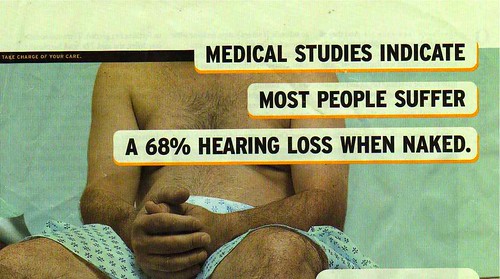
- when we’re stressed our hearing can actually tank by up to 68% like the naked hairy guy above – talk about not being able to respond to learners!
- as trainers when we’re stressed we default to our level of preparation
- to help you and your brain avoid the effects of stress create a training supplies kit that goes with you to every training (no matter the audience or the content)
- mine’s in a ziplock plastic bag so I can easily see what’s in there – it’s full of fasteners, chalk, whiteboard markers, tape, scissors, kleenex etc.
- easy peasy – pack and go
7. Avoid the hairy, naked guy; part B
- as a trainer when our brain’s under stress (we’re behind time, a participant is being particularly challenging or we’ve just realized we’ve been training with bits of lunch stuck between our teeth) we’re not primed to be operating at peak efficiency
- for proof just look at said hairy, naked guy trying to absorb his doctor’s advice
- to help you avoid him and his state make your training agenda your friend
- make your training agenda easy to read by making the font larger than you normally would
- underline bits of your agenda that have a corresponding handout
- highlight parts of your agenda that have a corresponding powerpoint slide
- if you’re co-facilitating, highlight (in a different colour) the parts of your agenda that your colleague is responsible for
- if you do find you’ve had spinach stuck in your teeth for the last few hours at least you’ll be able to easily find your place in the schedule
8. ‘Ah ha’ is most powerful when preceded by ‘huh?!’
- curiousity is to the brain what a cold, glass of lemonade is to a thirsty throat on a scorching hot summer’s day
- our brains LOVE being curious – they seek to satisfy that curiousity
- as the Heath brothers talk about in their book Made to Stick the ah ha of discovery, of powerful learning is most powerful when preceded by huh?! or what’s going on, you have my attention, I’m engaged, I’m paying attention
- create learning situations that arouse learner’s curiousity and they’ll be powerfully motivated to satisfy that curiousity
- confession: I used this strategy by creating posts called bumblebee butts and avoiding naked, hairy guys
9. Once upon a time
- we all want learners who are engaged and curious (see point #8) and one way to get them there is to tell engaging, true stories
- stories are a powerful shortcut to great learning and increased retention
- I have a whole back pocket full of stories at the ready – there’s the one about training in East Africa when at night I had to watch out for hippos and during the day monkeys were on my radar
- make it real, make it personal and have several at the ready
- most of all make sure your stories are related to your learning objectives
10. Group groans
- group groans, a.k.a. learning activities that are embarrassing and/or silly, dampen learning faster than your teenager can come up with multiple excuses as to why their homework’s not done
- if participants feel embarrassed or are made to feel silly their brains are focused on keeping them safe, not on learning
- group groans are defined by the learner’s perspective, not ours – you may find an activity engaging but if it looks like your participants are sucking on lemons ditch it and change tracks fast
- still not sure what a group groan is? Take a listen. It’s any activity that prompts a participant to audibly or inaudibly do this: group groan
So there you have it – 10 tips for trainers- from bumblebee butts & booty to avoiding hairy, naked guys.
I welcome any tips you’d like to share. Please feel free.
Tags: ah ha, curiousity, group groan, self-care, story, storytelling, stress, training tips
10 tips for trainers part one: bumblebee butts & booty
Posted by Lee-Anne Ragan | Filed under Communication, Diversity & culture, Teambuilding, Training & development

It’s my birthday tomorrow and as tomorrow’s not a usual day for posting I thought I’d give you a gift today.
Ever since I hit the earth some 4+ decades ago I’ve not had to wait for Christmas to open gifts so I thought I’d share the bounty with you, my dear blog reader, with you. Thanks for your readership. I hope you enjoy this gift- 10 tips for trainers part one (part two comes next post).
1. Take care of your bumblebee butt
- no I’ve not gotten into the nog, rather I’m taking a page from bumblebees. In order to communicate, from one bee to another how to find the source of nectar bumblebees do a cute, hairy, little butt dance. Yep, they shake their booty to communicate their treasure map.
- turns out though that when they’re tired their dance suffers and so too do the instructions.
- it’s the same with us trainers. Training’s really hard work. If you want to shake your booty and have all neurons firing you’ve got to take care of yourself.
- get sleep, eat well, bring a snack with you. If it’s going to be a conflictual setting bring lavender spray.
- bring and/or do whatever helps you be your best so you can do your best for the learners.
2. Nix the jibber jabber ‘tude
- humour is a strategic tool for training because when participants are laughing they’re using the same part of their brain they use for strategic, critical and innovative thinking
- the strategic use of humour (and I underscore strategic, no clown noses or fake dog poo) primes the brain for learning
- so don’t check your sense of humour at the door like the judge asks in the clip below, rather embrace it and encourage your learners too as well
3. Praxis
- other than a luscious word that rolls off the tongue, praxis is one of the most underutilized and potent tips for training
- praxis is a tenant of popular education and it simply means constantly cycling back and forth between action and theory
- great trainings take full advantage of this, adding some theory / information and then anchoring it with practice / application / experience, then back to more theory / information
- rinse, repeat – practice your praxis
4. Get your free flishtube
- it’s free, it’s easy to use and most of all it has great impact on learning – it’s flishtube a.k.a. Flickr, Delicious and Youtube
- these examples of educational technology really add oomph and they’re fun to use
- Flickr is a photo sharing site; by doing an advanced search you can find gorgeous photos with a Creative Commons license that gives you the artist’s permission to use. Here’s my Flickr account – you can see not only photos I’ve taken and used in trainings but also my favourites (other people’s photos I’ve used in blog posts; always with credit).
- how many times have you found a great resource on the web only to not be able to find it later. Enter Delicious, a social bookmarking site – click on my Delicious account and you instantly have free access to some 1500 training resources I’ve tagged on the web.
- if I have to tell you that Youtube is a video sharing site I seriously want the address of the cave you’ve been living in. You can find almost anything on Youtube and it’s a powerful way to illustrate your training points. Here’s my Youtube channel for some examples of videos I’ve made and use in training.
- whichever educational tech tools you use make sure they are anchored in your learning objectives
5. Don’t default to your personal vault
- deeply buried, in the cobweb corners of your mind vault are your assumptions about the RIGHT way to learn, which translated means the way YOU learn
- unless we take out those assumptions and dust them off we’re at risk of teaching how we like to learn … which is great … for the portion of your learners who happen to learn like you
- examine your training content and delivery methods to make sure they’re both accessible and inclusive
- don’t default to your personal vault or you’ll unwittingly exclude learners
So there you have it – the first half of 10 tips for trainers- bumblebee butts & booty. See the next post for part two – avoiding hairy, naked guys.
I welcome any tips you’d like to share. Please feel free.
Tags: access, bee, birthday, bumblebee, delicious, flickr, humor, humour, inclusion, popular education, praxis, self-care, tip, tips, youtube
Are you ‘Educating for a Change?’
Posted by Lee-Anne Ragan | Filed under Change management & wellness, Training & development
Educating for a change is one of my all time favourite books. It’s a lovely blend of:
1. Explaining what popular education is and why it’s important
2. Example activities that you can use to effect change
As a learning and development specialist do you know what your pedagogy is?
Pedagogy technically means the teaching of children but it’s a popular term so we’ll stick with it. The so-called correct term is andragogy but that technically means the teaching of men so it’s not all that inclusive either.
Pedagogy has to do with which particular methods and practices you use as a trainer. There are many different pedagogies.
One kind of pedagogy is popular education, which lays out that education should:
– lead to social change
– be cooperative
– recognize everyone is a teacher and everyone is a learner
– incorporate praxis (a constant cycling back and forth between theory and action)
– be respectful
It’s hard to argue with any of the above but I’m sure you can easily think of times when you’ve been in a workshop where one or more haven’t been followed. My 8:30 am university class with a prof who lectured from notes so old they were yellowed comes to mind.
Once you know your pedagogy / pedagogies it’s easier to design meaningful learning opportunities. I use a blend of:
– popular education
– brain based learning
– experiential learning
– adult education
As learning and development specialists we’re in the business of change. By laying out interesting, intriguing learning opportunities we are inviting our participants to change in some way.
Like what you’ve read? Check out the book, a Canadian bestseller, now out of print, Educating for a Change, which you can download for free by clicking on the link. Happy holidays!
The Educating for a Change resource is included in Rock.Paper.Scissors’ most recent e-newsletter. Click on the link to see the newsletter and get more information about ‘Learning about change & the power of music to rock the world from United Nations ‘Messenger of Truth’ Sara Mitaru©’.
Tags: adult education, andragogy, brain based learning, experiential education, pedagogy, popular education