Good Deed Feed – what you look for may be just what you find
Posted by Lee-Anne Ragan | Filed under Change management & wellness

I saw this ‘good deed feed’ in the UK Metro newspaper & had to share it.
If you had your own good deed feed what would you put on it in the world of work? In the world of play?
What you look for may be just what you find.
Here are some examples from a July 2012 issue.
To the girl who put a flower in my fleece pocket at Green Park on Saturday, you really cheered me up. Thank you. ~ Grateful, London
Thank you to the kind man and lady who stopped on the hard shoulder and offered me a lift when I was on my way to Gatwick. My taxi had broken down and the driver was clueless. I wouldn’t have made my flight without you. ~ Girl with the Pink Case, London
Thanks to the kind station assistant at the Harringay Green Lanes station who gave my daughter 70p for her train fare when she had to make an unexpected journey to meet me. ~ Michelle, London
Thank you to my dad who has woken up at 6:30am everyday for the past year so we can share a lift to the station. Enjoy the lie-ins when I’m back at uni. ~ Heed, Hertfordshire

Tags: change management, good deed, Wellness
What would you do with 148 bad boys?
Posted by Lee-Anne Ragan | Filed under Communication, Diversity & culture

Check your perspective at the door. Literally.
Watch the clip below up to 58 seconds. Then stop.
Ask yourself what you’d do.
Then continue.
Perspective – it’s a noose around our neck or a world enhancing view.
~~TGIF- each Friday I rejig & re-post a blog entry from my www.life-lenses.com blog, which is about enhancing our perspective & worldview.~~
Tags: bad boys, perspective
‘A head on approach to tackling water conservation’ plus a brilliant training & development technique
Posted by Lee-Anne Ragan | Filed under Humor & comedy, Training & development

This is a brilliant concept by photographer Peter Holmes, who according to an article from UBC ‘has a head on approach to tackling complacency around water conservation.’

Here’s Germany with 6.3 litres per person per hour
Simply put, Peter convinces his subjects to have the average amount of water a citizen from various cities & countries uses per hour, dumped over their head!
The woman above represents Serbia, which uses 4.5 litres of water per person per hour.

Spain’s average consumption is 12.1 litres/person/hour
It’s brilliant.
It’s visual.
It’s educational.
It’s a silk wrapped hammer – it hits you over the head with its message but you don’t necessarily realize it.
Much better than reading a ton of mind-numbing stats.
It’s an effective, creative training & development technique.

Vancouver’s average consumption is 12.3 litres/person/hour
The project ‘combines art and math to create a message and a reaction in the observer: that fresh water is a precious resource under alarming stress about which most of us are oddly detached and complacent.’
BTW * The figures are calculated by dividing the input of treated, potable water by population. It does not include agricultural, thermoelectric or industrial uses, but does include restaurants and light industry within the municipal limits.

The average American uses 23.75 litres of water every hour

California’s is a whopping 32 litres/person/hour
Tags: creativity, peter holmes
From complicated report cards to great graphics- how report cards can help us learn what to do & not to do
Posted by Lee-Anne Ragan | Filed under Training & development

As the new school year draws closer (or has already begun here in Kenya) parents gird their loins for the disassembling process of understanding their kids’ report cards. What should be a relatively simple snapshot is often ambiguous & hard to understand.
That’s why I loved the article in the Globe & Mail that had this graphic.
It’s clean. It’s highly visual. It’s colourful. It’s inviting. It’s easy to understand. It’s informative.
As training & development professionals we can learn a lot from this example (whether or not you have kids running you ragged or not).
From training feedback forms to employee performance assessments to other types of assessment & evaluation how can we make them clean, visual, colourful, inviting, easy to understand & informative?
Two tools I frequently use are comfight (for appealing visuals) & word clouds. One tool I’m starting to use is graphic facilitation. What about you?
(Now if only my new to middle schooler’s schedule was as easy to read!)
Tags: compfight, evaluation, feedback, graphic facilitation, word clouds
Change your seat, change your view – how about this chair?
Posted by Lee-Anne Ragan | Filed under Change management & wellness

We have an unparalleled ability to analyze, create, cogitate and ruminate. That very ability can get us in trouble if our view or perspective is slanted.
Take a look.
What do you see?
~~TGIF- each Friday I rejig & re-post a blog entry from my www.life-lenses.com blog, which is about enhancing our perspective & worldview.~~
Tags: change management, perspective
25 years of cataloguing 137,000 Moghul documents
Posted by Lee-Anne Ragan | Filed under Business & organizational development

Since 1961 a team has been hard at work in India cataloguing 137,000 documents from the Moghul era (Moghuls are descendants of Genghis Khan). The team has dwindled in size to only 4, because there are only 4 people who can read them.
In an article in the Globe & Mail Stephanie Nolen says “It is very often argued that the institution of archiving began with the British – the authority keeping a record of their activities – but here is such a large collection of documents which are essentially archival,” said Mushirul Hasan, director of the National Archives. The Moghuls, descendants of Genghis Khan, controlled the subcontinent for nearly 300 years. They nurtured arts and literature as well as waging war, and left a staggering legacy in India that includes the Taj Mahal and other monuments.
Many are ‘farman,’ or imperial orders – the Emperor Aurangzeb, for example, buying elephants and camels to wage a military campaign, allotting land to a loyal subject, hiring civil servants and collecting taxes.
What do you document? The oldest documents being catalogued are 354 years old! What would your records have to say about you some 350 years from now? How do you document your knowledge management?
Tags: document, knowledge management
See ME! Relate to ME! A guide for managing change thanks to Puma
Posted by Lee-Anne Ragan | Filed under Change management & wellness

My son & I bought some new soccer equipment for him the other day. Afterwards he was ogling his new purchases, including the box that the soccer shoes came in (see said box above).
If you take a closer look, the cleverly designed box compares your shoe size to other things. If, for example, you’re an infant size 5 then your foot is the same size as a blues harmonica (see the side of the box picture below).

A wee bit bigger than an infant?
If you’re a men’s size 15 1/2 your foot is the same size purportedly as a gangsters’ gold chain (see second picture for more comparisons).
This is a great example of relating something known and familiar (your feet) to something new and creative.

It changes your perspective of your feet by comparing what you know and are (presumably) comfortable with to something novel.
When you’re introducing a new concept, especially one that you think may be unwelcome or feared, start with what’s known and familiar.
For a Mountain Life Lens™ start with the big picture. For a Carrot Life Lens™ start with the details.
For a Journey Life Lens™ start with focusing on the process, whereas for a Destination Life Lens™ let people know where you’re headed.
For a Heart Life Lens™ focus on intuition, but for a Head Life Lens™ pay attention to the facts.
And finally for a Stop Life Lens™ make sure there’s time for reflection while with a Go Life Lens™ let people jump in and get started.
~~TGIF- each Friday I rejig & re-post a blog entry from my www.life-lenses.com blog, which is about enhancing our perspective & worldview.~~
Tags: change management
Theory is when you know everything but nothing works
Posted by Lee-Anne Ragan | Filed under Training & development
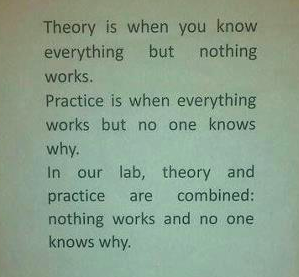
As a training & development expert I laughed out loud when I read this.
Some participants LOVE theory – give them sources and concepts, reports & ruminations, inspirations & ideas, as well as books & bibliographies.
Some participants LOVE action – give them activities & exercises, puzzles & practice time, as well as scenarios & simulations.
Put the theory & action together & you’ve got powerful learning. It’s called praxis (a term from popular education pedagogy).
BTW – I came to this image through Melanda Schmid’s facebook page & it’s originally posted on George Takai’s facebook page.
Tags: practice, praxis, theory
Alan Alda’s ‘What’s a flame?’ contest where the judges are 11 year olds
Posted by Lee-Anne Ragan | Filed under Training & development
You may have heard of Alan Alda. He’s been around forever it seems. Who can forget his character Hawkeye on the long running TV series M.A.S.H.? Turns out he also has an avid interest in science, stemming from his early years, which he put to good use in a contest.
I remembered this moment from when I was 11. I was fascinated with the flame at the end of a candle and thought about it for days — and I had so many questions. What is it? It’s not like anything else I’ve ever seen. You can put your finger through it, it doesn’t have any substance, but it’s very hot. What’s going on in a flame? So I asked my teacher and she said, “It’s oxidation.” And that’s all she said. I didn’t know what oxidation was, so how was that an answer? She was just giving “flame” another name.
As a result of this early memory he cooked up a contest where scientists were asked to explain what fire is. The judges where 11 year old kids.
The winner was Ben Ames, from the University of Innsbruck, Austria. You can see his winning entry below. From a training & development perspective he puts the following principles to good use:
- curiousity (our brains love to satiate our curiousity) – how come the guy’s in chains by fire?
- creativity – 11 year olds as judges? Enough said.
- relating the unfamiliar to the familiar – he uses things that are familiar (candles, popsicles, water) as springboards to teach complex concepts
- visual effects – he puts cartoon characters, symbols & other visuals to good use
- auditory effects – he uses a great narrator, with a voice that varies in intensity, modulation, rhythm & emotion
- humour – love the boxing ring!
- repeat. I repeat. He uses repetition effectively. Chemiluminescence anyone?
- rhythm – the song he uses makes good use of rhythm & guess what? Our brains LOVE rhythm
Check it out!
What is a Flame from Ben Ames on Vimeo.
Tags: alan alda, ben ames, fire challenge, humour
A creative ode to the linoleum temple (thanks to Elizabeth Gilbert & Balkan Beat Box)
Posted by Lee-Anne Ragan | Filed under Creativity & innovation, Training & development

Elizabeth Gilbert, in her book Committed: a Love Story, calls the kitchen the ‘linoleum temple.’ Love it.
Here’s the linoleum temple in all it’s musical, yes musical, glory (see video below). It’s an ode to creativity.
Notice the elements of surprise & the unusual use of everyday objects. Two very good elements to use in creativity & innovation plus in training & development.
So on with the show. Enjoy Balkan Beat Box’s Move It video.
FYI The full quote from Elizabeth Gilbert’s book is: The marital kitchen can become something like a small linoleum temple where we are called up daily to practice forgiveness, as we ourselves would like to be forgiven.