Learning from a hole in the wall
Posted by Lee-Anne Ragan | Filed under Creativity & innovation, Human resources, Social Responsibility, Training & development, Travel

Check out the video below about the TED hole in the wall educational experiment (forward to 7:15 min). It’s the work of Dr. Sugata Mitra, of India.
His office butted up against a slum and one day he punched a hole in his wall and stuck a computer in it. A computer that faced out, into the slum.
Then he watched.
He learned a lot about self-organizing and alternative education …. from children.
- It took a 13 year old merely 8 minutes to teach himself how to browse the net
- He saw an 8 year old teach a 6 year old how to browse the web … despite not knowing English
- Non-English speaking kids found websites ….. to teach themselves the English alphabet
- Often younger children were found teaching older kids

Tags: alternative education, dr sugata mitra, education, hole in the wall, India, learning, Learning Theories, pedagogy, self-organizing, slums, Social Responsibility, Sugata Mitra, TED, values
5 lessons on learning from international dancing sensation ‘Where the hell is Matt?’
Posted by Lee-Anne Ragan | Filed under Communication, Creativity & innovation, Training & development, Travel

As I’ve recently been working in Turkey, traveling is on my brain. Hence the focus on international learning and specifically lessons on learning from international dance sensation Matt, of ‘Where the Hell is Matt’ fame.
If this makes no sense to you then I’m tempted to ask ‘where the hell have you been?’ but that would be rude. A quick tally of his video hits is 50 million plus. Instead a quick recap:
- Matt is a young guy who essentially does a dance that looks suspiciously like a cross between a drunken, dancing leprechaun and a head bobbing pigeon
- that is to say, he’s unrefined in his dancing – it’s not a particular asset of his
- where he shines is dancing the world over and videoing folks joining in
- if this still sounds dubious and odd to you see the second video for more information, it’s a clip of his gratitude dance
Okay, now that we’re all on the same dance stage so to speak, how the hell did Matt get people to dance with him? Glad you asked. That’s the gist of a talk he gave (which you can view in the video directly below).
Tags: dancing, learning, learning & development, matt, organized, simple, social, strength, training & development, unique, weakness, where the hell is matt
Learning means converting & translating
Posted by Lee-Anne Ragan | Filed under Communication, Training & development, Travel

I was recently in Turkey doing program evaluation training for the United Nations, which meant carrying a variety of ubiquitous plug adapters. I laughed at the above combination of plugs – all feeding into one that would fit the hotel outlet, allowing computer and IPhone to charge.
The need to convert, change or adapt in order to make things relevant and workable for my current circumstances caught my attention.
In the realm of plugs this can be essential. Especially as I’ve been known to singe my hair with my curling iron, as I mistook the plug adapter for the voltage adapter. (Putting a gadget that was designed for 120 through 220 is not a good combo, or so the smell of burned hair taught me.)
The learning and development field is ripe for new learning opportunities served up via new technology. Each need their own tweeks and adaptation. Examples?
- my VA (virtual assistant) is situated in India – technology allows us to communicate almost seamlessly. Translation? I need to remember that I’m working across cultures and be explicit with my instructions.
- at the end of all my workshops I now share my Delicious link – enabling participants to access a wide range of learning resources. Tweek required? I need to remember to explain what a social bookmarking site is, as it’s not common knowledge (yet).
- many of my workshops now include short video clips (thanks to Youtube) that reinforce and anchor the concepts that I teach. Conversion? Getting Internet accessibility in the training room can be a pain or downright impossible.
- Hootsuite amalgamates all my social media feeds into one place – easily and conveniently allowing me to follow other learning and development specialists. Adaptation? I need to be strategic about who I’m following and how much time I spend on social media, while at the same time recognizing that it’s a critical part of my business now.
Learning means converting, translating, tweeking and adapting content in order to get and hold the attention of participants.
No attention = no learning.
Tags: delicious, Get Friday, hootsuite, social bookmarking, technology, turkey, united nations, virtual assistant, youtube
Putting learning technology in the back seat – where it belongs
Posted by Lee-Anne Ragan | Filed under Communication, Diversity & culture, Training & development, Travel
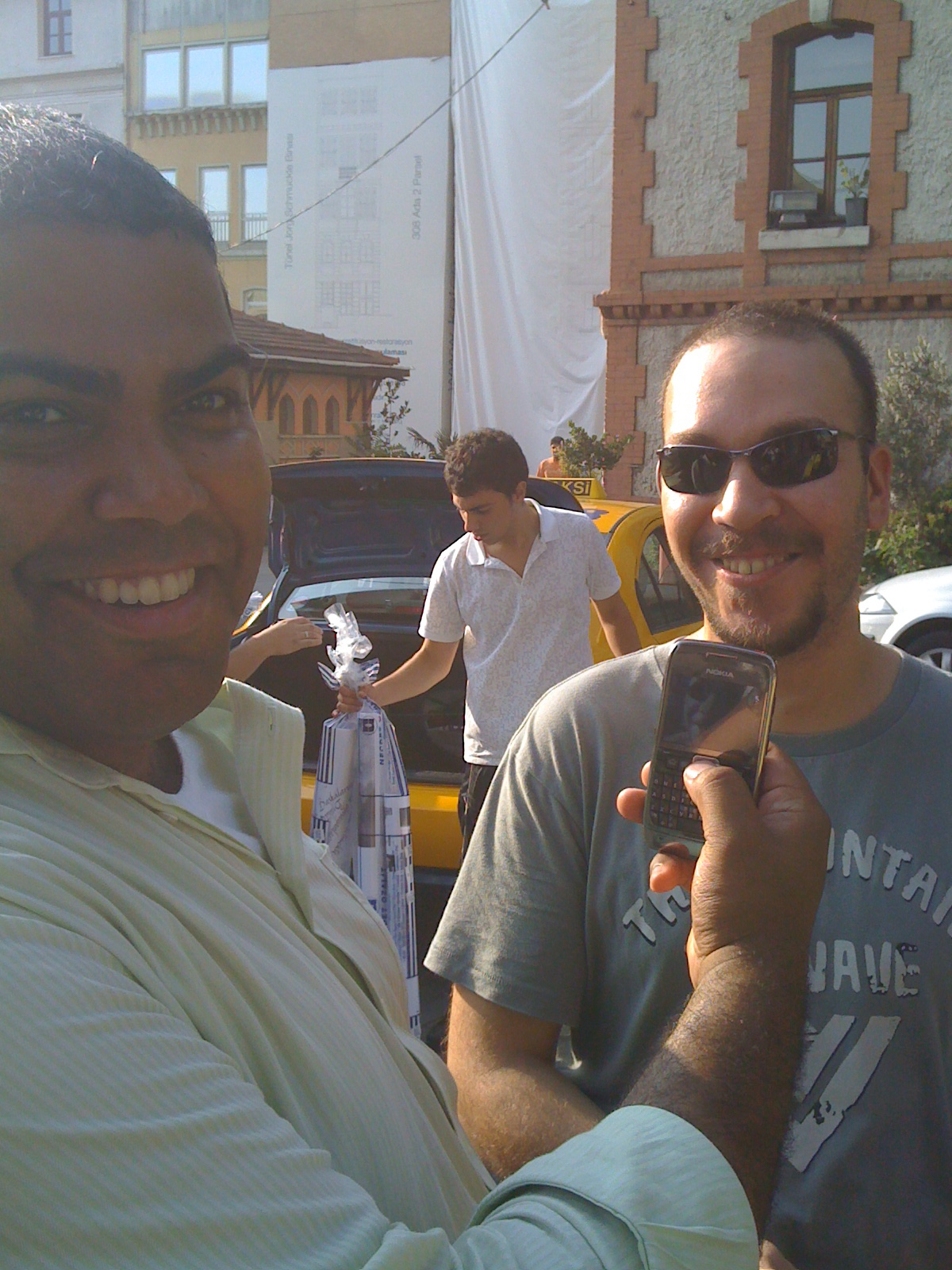
At its best learning technology should disappear into the background, allowing the learning to shine.
At its worst technology is so much in the foreground that nothing else is discernible (enter video conferences where participant faces look like something a Star Wars make-up artist dreamed up while on drugs).
Recently, while doing some training in Turkey, I discovered an example of putting technology in the backseat. Check it out.
I was interviewing Sara Mitaru in a local recording studio for an upcoming newsletter. She’s a United Nations designated Messenger of Truth, musician, mama to be and entrepreneur. When it came time for our ride to pick us up the driver was no where to be found and what’s more our plans had changed: we all wanted to go out for dinner together and later the Africans wanted to get some groceries.
This posed a problem as the driver spoke no English and we spoke no Turkish. How to communicate the changes?
Enter technology in the ever helpful background. Above is a picture of a local Turkish speaking musician dictating the name of the place we wanted the driver to take us …. in Turkish…. into an IPhone app on Karun’s phone. Karun later played the recording to the driver. Below is a recording of what it sounded like.
Et voila! Technology in the background, learning up front in the driver’s seat. Where it belongs.
Tags: karun koernig, learning, learning technology, messenger of truth, sara mitaru, technology, turkey, united nations
Turkish swirling smoke, whirling dervishes & Wi Fi; learning with the old & new
Posted by Lee-Anne Ragan | Filed under Training & development, Travel

I’m in an outdoor restaurant watching folks rest up after a long day. I’m not sure which is more responsible for the slouching against the low slung couches – the heat and humidity or perhaps not having eaten all day, for it’s the first day of Ramadan, the Islamic month of fasting.
It’s my last night in Istanbul before heading home. I’ve been here teaching a couple of workshops on program evaluation on behalf of the United Nations.
On one side of the restaurant is an ancient cobble stone street lined with carpet and ceramic shops. On the other is the Blue Mosque and Hagia Sophia, both set against an inky black sky, which is lightened only by the stark white seagulls which wheel about freely causing a magnificent contrast to the black velvet backdrop. The sun has long past set and families are out and about, replenishing after fasting all day. There’s an air of celebration in the air.
Back at the restaurant there is an ancient tradition being played out on stage. Three musicians toss out music notes which ride the air currents with a combination of aplomb and abandon. A whirling dervish turns rhythmically in time to the music. While I watch, his tall, thick hat rests confidently atop his head, despite the constant turning. With one hand facing up and one hand down, head cocked slightly to the side, he spins and spins in place, causing his long white robes to ripple and flare like the track of some ancient roller coaster.
Whirling dervishes are followers of Rumi, a 13th century mystic and poet. The turning or whirling is part of a religious ceremony that honours God. Placement of the hands represents both giving and receiving.
My view of the whirling dervish is somewhat obscured by the whorls of smoke from the many people smoking hookahs or water pipes. The tendrils of smoke drift lazily wherever the air currents take them. As an avid non-smoker I enjoy the old, romantic notion of smoke without the acrid tobacco stench for these pipes contain scents of apple, mint, lemon etc.

Water pipe cords hanging in the market, waiting for use
As I’m lulled by a sated stomach, the music and the dance, my mind wanders back to earlier in the day. While walking past the Blue Mosque (a mere infant at only 400 years old) and near Hagia Sophia (the crone at 1600 years old) I noticed a sign for free Wi-Fi. At first it seems incongruous but then settles in as more normal than not. Pulling out my IPhone I found I could indeed pick up my email.
I marvel at the combination of old and new.
And I wonder.
Like the blue tiles that gives the Blue Mosque it’s name, I wonder at what we’ve come to know about learning and development that will survive some 400 years forward.
Like the newly offered Wi-Fi at the foot of such history, I wonder at what we’ve yet to know about learning and development, or are only just coming to know.
Like a bride’s tradition, “something old, something new, something borrowed, something blue” I’ll take my learning with some of the old AND some of the new.
Click on the link for a live music clip I recorded at the restaurant: Turkish music in Istanbul
Tags: blue mosque, hagia sophia, islamic, istanbul, learning, old and new, ramadan, turkey, whirling dervishes, wi fi
A great example of evocative learning & development
Posted by Lee-Anne Ragan | Filed under Diversity & culture, Training & development

Good training uses good design.
Good learning and development ties new information to knowledge that participants bring with them.
Good training takes complex concepts and presents them in simple but not simplistic ways.
Good learning and development creates ‘ah ha’ moments that learners discover on their own.
Good training is creative.
Good learning and development opens up new perspectives and beckons learners in.
Good training invokes emotion.
Good learning and development invites and makes space for action and application.
Here’s an example.
Tags: ah ha moments, creativity & innovation, emotion. pedagogy, learning & development, perspective, training & development
How do you like your learning – with or without olives?
Posted by Lee-Anne Ragan | Filed under Communication, Diversity & culture, Training & development

Being in Istanbul, Turkey to do a program evaluation training on behalf of the United Nations naturally means eating a Turkish breakfast. This morning I found myself musing about learning over olives. Yes olives.
I was watching the pile of uneaten olives grow on the plates of my breakfast mates. David Muthami, a music producer from Kenya and Sara Mitaru, a Messenger of Truth also from Kenya, were talking traditional Turkish breakfast. If you haven’t eaten one, a traditional Turkish breakfast that is, they usually has some combination of fresh bread, tomatoes, cucumber, cheese, hard boiled egg and olives. This is my idea of a great breakfast, which I’m known to attack with gusto.
Olives are an acquired taste however. David described them as tasting like sand mixed with vinegar, salt and sour milk. Which other than making me think this guy has a way with words, got me thinking about learning.
What is normal, natural and right for one is abnormal, unnatural and not right for another. I love olives and eating them at breakfast is perfectly fine with me. David, not so much. As his face soured at the thought of eating an olive, I thought it made for a great comparison for learning.
Learning atmospheres – do you like yours quiet and serene or noisy and rambunctious? Solo or with a crowd?
Learning content – do you like to dive right in and try new things or do you prefer to take a more cautious, thoughtful approach?
Learning style – do you prefer to learn by seeing, hearing and/or doing?
If you have a certain preference (say quiet reflection) and a trainer works from another approach (jump in, go, go, go) then it’s like asking David to wolf down olives gleefully and willingly. What is one person’s salty slice of heaven is another’s “sand mixed with vinegar, salt and sour milk”.
As learning and development specialists it’s our responsibility to provide a banquet of learning of opportunities so if someone chooses to pass on the olives there are lots of other tasty treats to tantalize their learning taste buds.

The olive man himself, David Muthami
Tags: david muthami, Diversity & culture, learning, learning atmosphere, learning content, learning styles, messengers of truth, sara mitaru, turkey
Training trouble? Activate shield deflector
Posted by Lee-Anne Ragan | Filed under Humor & comedy, Travel, Uncategorized

If you put yourself in the spotlight as a trainer, as a learning and development specialist, it follows that at times you’ll get burned. And that spotlight can be mighty hot. In my 20 plus years of designing and leading training workshops I’ve had my fair share of challenges:
- a particularly rude participant coupled with an insanely early gig (try being educational at 4 am)
- a training room where the heat was broken …. in the middle of winter
- realizing an hour into a training that the workshop had been advertised with two different room numbers and half the class was sitting in the other room mighty annoyed
- not having participant manuals show up for the first day of a two day training (that was based on the manual)
What helps when you find yourself sinking? When your stomach is floating somewhere above your body and your mouth is starting to rival the dryness of the Sahara?
Why activate your shield deflector of course.
Christine Comaford, in her book Rules for Renegades, talks about dealing with a particularly challenging supervisor when she worked at Microsoft. Her and her colleagues had a tradition, when ‘going in to battle’ with him – they’d touch their belts and pretend they were activating their shield deflector. It became a powerful ritual. One that was helpful in not getting sucked into a crazy making vortex.
And you? Knowing that challenges are part and parcel of all training, I suggest activating your own shield deflector next time you find yourself about to flounder. Square your shoulders, put a grin in your face and with shield in hand, dive into the fray.
Tags: christine comaford, inner mean girl, rules for renegades, shield deflector, training challenges
Our inner mean girl (aka the vile bitch that lives upstairs)
Posted by Lee-Anne Ragan | Filed under Conflict resolution, Humor & comedy, Training & development

Caveat: if you’re a guy reading this, simply imagine your inner mean guy or the vile arse that lives upstairs.
Who’s your worst enemy?
Likely it’s you. Yep. You.
How many times has the voice in your head grumbled:
- how could you possibly have something to teach anybody?
- no one will be interested to what you have to say
- everyone is smarter than you
- (fill in the blank with some other negative, self-deprecating comments)________________________
The voice in your head is what Amy Ahler calls our inner mean girl. She’s also what Christine Comaford, in her book Rules for Renegades, colourfully calls the vile bitch that lives upstairs. Whether you call her your mean girl or your vile bitch, we all have one. It’s the voice that undercuts our success, that holds us back for fear of failure, that expects every opportunity to turn sour.
It’s the voice that ‘awfulizes‘.
Make one tiny mistake and it swoops in predicting dire calamities at every turn. You’re going to end up on the streets naked because no one will pay you for your work, you won’t be able to even afford clothes, you will be featured in a 5 page spread in Time Magazine …. as the world’s biggest looser and you’ll die alone and heartbroken.
That my friend is ‘awfulizing’ and its author is your inner mean girl.
Don’t get me wrong, there is an inner voice that is helpful and wise. The difference is that voice comes from a place of wanting to help, wanting us to succeed rather than reveling in falling flat on our faces.
Amy Ahler encourages folks to draw their inner mean girl. Get really specific and get to know her. Find out what makes her tick. And I’ll add, to find out when it’s your inner mean girl (or vile bitch) talking and when it’s your sage voice of wisdom.
As trainers we need to brush off this invited guest. Interrupt the negative self talk. When I hear my own negative self talk I literally imagine brushing this interloper off of my shoulder, interrupting any nastiness she’s trying to whisper in my ear. I feel lighter when she’s gone and better able to focus.
We’ve got enough to worry about as learning and development specialists. The last thing we need is to let ourselves listen to nasty put-downs masquerading as sweet nothings.
Go on. Brush her off. I’ll hand you the broom.
Tags: amy ahler, christine comaford, inner mean girl, rules for renegades, self talk
Learning comes in all shapes, sizes & venues (including family reunions)
Posted by Lee-Anne Ragan | Filed under Communication, Diversity & culture, Training & development, Travel

Some prefer their learning delivered through stacks of facts. Facts lined up with their edges squared and precise, like the desks in an old classroom. Facts stuffed to (over)fill precious time. Trainers channeling their knowledge into (supposed) empty and (un)willing brains.
Others (in the know) realize that learning needs to be coupled with engagement. Learning can happen anywhere, even (especially) in the most unlikely situations. Like at family reunions.
I recently returned from one. A family reunion that is. Amongst the wisps of campfire smoke, which looked like the arms of an evocative belly dancer, there were learning’s rife for the picking.
I’m getting ahead of myself though. Let me set the stage for you first.
Recently I wrote a popular post about ‘who am I? One of the things that defines me is that I’m a learner. I love to learn, I love learning about how people learn and I especially adore playing a role in others learning. So when I set out with my family to journey more than 2500 miles / 4000 km by driving halfway across Canada and back, I also set out to learn.
As we journeyed amongst this nation of migrants, we joined the ribbon of campers and semi’s moving families and goods. We watched endless trains wind through the landscape like necklaces adorning the rolling hills. We moved amongst the mountains, their craggy tops looking like an old man’s eyebrows, wild, wayward and untamed.
As we got closer to our prairie destination I reflected on my origins. I was conceived in the polar bear capital of Canada to parents who were far from home, their prairie home. When they realized they were pregnant they decided to move from the icy, far north to sunny California. Once they hit Vancouver however, they stopped and I’d found a home.
Prairie blood still runs deep in my DNA, the same prairies which we were returning to. Returning, on this once every three year jaunt, to relatives who make their way in the world farming, raising livestock, working the rigs and driving trucks. All of which are a far cry from my daily, urban life.
As we rolled past fields that stretched as far as the horizon, I looked at the huge pieces of farm machinery, some of which looked like massive green crickets waiting to pounce. I remembered being gently teased as a kid, when upon visiting relatives, I couldn’t identify the most basic of farming equipment.
When we finally arrived I was immersed in this big, old family of mine, all descendants of my beloved Nana and her brothers and sisters. I jumped into a learning culture.
I learned from relatives who raise and sell bulls. I was gobsmacked (after realizing they weren’t teasing me) that measuring bull’s testicles and having sperm tested is all part and parcel of selling them. I listened, as my mouth watered, to the large menu of homemade food that’s made when a bull sale is on, when up to 200 interested customers get fed.
I learned about a new house being built that would be ready for move in at harvest time …. and as someone who has spent almost her entire life in and around cities, I had to ask for a translation of when that exactly was.
I watched my cousin get my 13 year old kid up on the impromptu dance floor, a grassy, flat patch at the campground, and teach him how to dance. How to move his body to the rhythm.
I learned about the breath sucking, heart clenching effects of grief as two relatives fell into each others arms crying. One had lost an adult daughter in a horrific car crash and one had lost a husband to drowning. I also watched the heart lifting, chuckle inducing effects that a new baby had on these same women, as the grief slowly, slowly ebbs.
I watched in marvel how the family rallied, when some relatives got sick from food poisoning and had to be hospitalized. I drove my aunt and her husband into a tiny, rural hospital in his big truck where they were treated by a doctor from South Africa. Relatives just came. They came to see what they could do. Hours in, plates piled high with homemade food showed up. I sat in the hospital driveway, as the sun was setting on the prairie horizon, in this tiny town, reminiscing with relatives and marveling at how different this life was.
As we turned towards home and headed into the sun, I listened to Leonard Cohen ‘ring the bells that still can ring, forget your perfect offering, there is a crack in everything, that’s how the light gets in’. I wondered what my kid’s lives would be like if we were living on the prairies. Far different from most of my relatives who spend their entire lives in tiny towns, I wondered about the effects we, my husband and I, trade in when we travel far and wide around this old globe.
As I turned my face to the sun and continued to follow the gray ribbon of highway home, I mostly wondered about learning, in all its shapes and sizes. I thought about creating cultures of learning and how grateful I am to do that for a living. And how grateful I am to carry that desire to learn everywhere I go, even into the rural wilds of prairie Canada where I meet up with much loved relatives and fill up my brain with both our lovely differences and similarities.
I learned the distance we travel is not always measured in miles and our minds work better if they are in tandem with our hearts.
Tags: change management & wellness, engagement, family, learning, pedagogy, story