You can make a difference. Will you?
Posted by Lee-Anne Ragan | Filed under Change management & wellness

‘nuf said.

Tags: change
Learning curve: how do you know when you’ve ‘got it’? When your participants have got it?
Posted by Lee-Anne Ragan | Filed under Change management & wellness, Training & development, Travel

This soap aisle seemed very daunting at first when I was trying to find a particular kind of soap.
Lessons in learning curves from Kenyan soap.
If you’re a regular reader you’ll know that I’ve recently moved from Vancouver to Nairobi, Kenya. The learning curve is sometimes fun and fluid, and sometimes crazy and chaotic.
It’s got me thinking about how we, as trainers, know when we’ve ‘got it’? When our participants have ‘got it’?
Aside from the static sound of ‘getting it’ and knowing of course that knowledge and what you do with it is forever fluid, let’s continue.
For moving to a new home in another culture and country is ‘getting it’:
- being able to shop for groceries and having a relatively good idea of what to get where? The daunting soap aisle above got narrower in focus until I’m now able to find what I’m looking for. See the two pictures below, including the sought after OMO soap.


- knowing your new (10 digit!) phone number without having to look it up on your Iphone?
- feeling like driving on the left hand side of the road is your new normal (and when watching a movie where cars are driving on the right hand side, feeling slightly discombobulated)?
- NOT converting the local currency into your home currency (not there yet)
There are many indicators of ‘getting it’, some are knowledge based, some are feeling/comfort based and some others are behaviour/action based.
What are yours?
Tags: indicator, learning curve
Perspective and mamahood; how does your perspective affect your training?
Posted by Lee-Anne Ragan | Filed under Training & development

As a trainer our perspectives changes – depending on who we’re working with, what subject matter we’re teaching, how we’re feeling that day, our energy level and a million other things.
We think we’re neutral and objective but we’re not. We’re biased. Way biased.
We see things as only we see them. We see things based on our culture, our perspective, our history. We see things uniquely.
The trick is teasing out our perspective. Making the lenses that we see the world through visible.
Here’s a perspective on mamahood. It caught my eye because I have an almost 10 year old and 14 year old. It made me chuckle. I hope it does for you as well.
It’s all about perspective.
3 yrs old: “Mommy, I love you”
10 yrs old: “Mom whatever!”
16 yrs old: “My Mom is so annoying!”
18 yrs old: “I wanna leave this house.”
25 yrs old: “Mom, you were right.”
30 yrs old: “I wanna go back to my Mom’s house.”
50 yrs old: “I don’t wanna lose my Mom.”
70 yrs old: “I would give up EVERYTHING for my Mom to be here ……with me.”
(Despite being all over the internet I couldn’t find an attribution for this perspective. Thanks, whoever you are.)
How does your perspective affect your training?
Tags: learning, mamahood, perspective
What type of change are you trying to effect? Does it line up with your core purpose & power relationships?
Posted by Lee-Anne Ragan | Filed under Change management & wellness

At a recent workshop I attended, by Steve Waddell, put on by Ashoka, here in Nairobi, Steve displayed a chart about GAN’S (Global Action Networks) work on transformation.
I’m fascinated by all things related to change and transformation – how we manage it (or don’t), how we deal (or don’t) and how the same change can be invigorating for some and a death blow to others.
Take a look at his analysis in the chart below. It applies to more than just GAN’s.
But first, in your work, be it training and development, human resources generalist, change agent specialist or other, ask yourself:
- what type of change are you trying to effect?
- what’s the core purpose?
- what are the power relationships?
Then see how your answers stack up to Steve’s below.

Tags: ashoka, change, perspective, steve waddell, transformation
A pirate’s guide to engaging training & development workshops
Posted by Lee-Anne Ragan | Filed under Humor & comedy, Training & development

Ever listen to a pirate say ‘arrrrrr’? They do it with commitment. With enthusiasm. With zest and zeal. Much like training and development.
Before I show you a sterling example, first here are 10 mistakes a trainer made during a workshop I was a participant in recently (no names have been used, in order to protect the guilty). I’ve classified the mistakes into themes and shown the percentages. They just might surprise you.
Oi! The workshop was boring and not very helpful. Here’s why.
- Using a monotonous tone of voice – good for putting participants to sleep, not good for keeping attention
- Using acronyms (abbreviations) a lot – made for a confusing time for me, the newbie
- Using a tiny font in the Powerpoint presentation – even with my glasses on I couldn’t read it
- Using Powerpoint screens that were FULL of words – too many words and no white space makes for difficult reading and comprehension
- Have a blurry Powerpoint screen – if you’re trying to irritate the participants, goal accomplished, otherwise frustration continues to ramp up
- Reading off the Powerpoint – trainer facing the screen, reading (in monotonous tone of voice), reading, and more reading
- Trainer faces 2 of the 12 participants. Period. Trainer only looks at two of the group, which makes them squirm and leaves the rest of us feeling ignored.
- Completely ignoring the person who came in late… and to make matters worse, there wasn’t a chair for her. She ended up leaving.
- Trainer leaves cell phone on. It rings twice.
- Trainer answers cell phone during workshop and takes the call!
I took notes for this blog post during the workshop. I divided the points into themes:
- things that make it too hard to learn
- things that lead to a lack of engagement
- things that make participants not feel included (access and inclusion issues)
Here are the percentages when I tallied when matching which error went with which theme(s):
- things that make it too hard to learn – 44%
- things that lead to a lack of engagement – 25%
- things that make participants not feel included (access and inclusion issues) – 31%
Notice I didn’t mention content. Despite fairly good content the training was a bust for me due to all the barriers.
Paying attention to HOW you’re teaching is as important (if not more important) than WHAT you’re teaching. Lesson learned?
Now about that pirate. Take a look and listen to the zest and zeal in this announcer’s voice – a role model for trainers.
Tags: enthusiasm, mistakes, pirate
Borrowed husbands = more money, more wine
Posted by Lee-Anne Ragan | Filed under Training & development

Sometimes as a trainer you gotta fake it til you make it. I don’t mean with your content expertise – participants will know in a nano-second if you don’t know your stuff. I also don’t mean with knowing how to teach – participants will sniff that out too PDQ.
What I mean is confidence. Self-confidence. Sometimes, especially when you’re new to training and development, you need to act more confident than you feel.
Or get a stand in to help.
Like Sandra Oldfield, Winemaker and Owner, Tinhorn Creek Vineyards, who had to borrow a husband. Her own husband in fact.
I didn’t know whether to laugh or cry as Sandra talked about being a newbie female winemaker and vineyard owner who needed a bank loan, regaling myself and others during the Forum for Women Entrepreneur’s gala event. When she started out as a vineyard owner it was rare to have a female at the helm. The banks wouldn’t take her seriously. And she seriously needed some cash.
Enter husband.
She had her husband stand next to her during the bank negotiations for a loan. It worked. She got the cash and some 15 years later she’s still successfully at it.
Talk about taking perspective into your own hands. Wonder if she still has to take her husband to the bank?
What have you done lately to bolster your confidence while training?
Tags: confidence, sandra oldfield, tinhorn creek vineyards
What ironing underwear can teach you about learning
Posted by Lee-Anne Ragan | Filed under Diversity & culture, Training & development

If you’re a regular ready you’ll know that I’ve recently moved to Africa. My learning curve is wonderfully curly and curious.
Take ironing underwear for instance. I am fortunate enough to have house help. My clothes are washed, dried and ironed for me. Even my underwear. Ironed.
Back home, my ‘ironing’ would consist of hanging said wrinkled piece of clothing on a hanger, putting it in the shower, batting some water on it, smoothing it down and leaving it be. When I came back it would be relatively wrinkle free.
And that’s the perspective I brought here. With my eyebrows reaching skyscraper heights in incredulity, who needs to have all their clothes ironed I thought, especially underwear ? I thought it was a waste of time. Not efficient. Decidedly odd.
That was then. This is now.
Turns out clothes are mostly hung outside to dry here. Turns out flies like to hang about. Turns out flies like to lay their eggs, especially on underwear.
Here’s the perspective altering fact; ironing kills the eggs.
Bring on the iron!
What perspective have you tried to transport from one situation to another with decided gaps and gaffs?
Tags: africa, culture, learning, perspective, teaching
How NOT to teach someone to swim (mis-match your learning domains)
Posted by Lee-Anne Ragan | Filed under Training & development
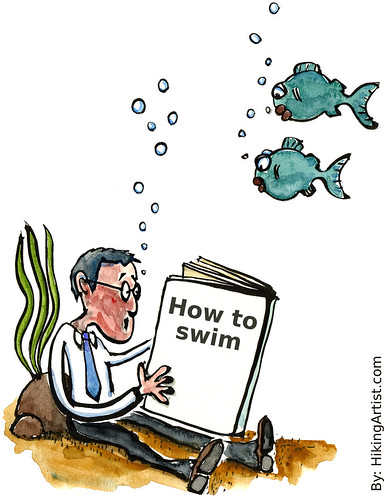
I had to laugh when I saw this cartoon. It’s such a great example of how NOT to teach someone to swim.
As a trainer you can be as engaging as possible but if the learning domains you’re using to teach don’t match your intended learning outcomes you’ve got a big problem.
In other words, you can lecture all you want on the perfect front crawl stroke but if participants don’t ever hit the pool and actually practice, learning is going down the drain (pun intended).
If you want participants to be able to DO something (kinesthetic domain) they have to DO that very thing in the training.
Not as I experienced in a computer course I took years ago. There was a huge audience, maybe 300 or so …. and 1 computer … the instructor’s.
I gritted my teeth and swore under my breath to not ever put myself in the same situation again. Even taking good notes wasn’t a substitute for getting my fingers on the keyboard. It was my intention to get better at Excel (eg a doing, kinesthetic goal) but by not being able to practice on a computer during the training, my learning was significantly hampered.
The other two learning domains are audio and visual. If you are training participants to be able to speak another language they must hear you speak it and practice speaking it themselves (the audio domain). Likewise if you’re teaching people how to rock PowerPoint or Prezi they have to be able to see examples (the visual domain).
So next time you’re developing a new training workshop (or reviewing an existing workshop) check to make sure your domains match.
Tags: learning domains
Training & development learning well September blog post round up
Posted by Lee-Anne Ragan | Filed under Training & development

September passed in a blur and you missed out on some Rock.Paper.Scissors’ blog posts? No worries. Here they are – laid out like a picnic for your perusing – here’s the Rock.Paper.Scissors’ monthly training & development round up. You’ll find all the blog posts for the month of September below.
Learn well in the training & development learning well.
Dive deep into the learning well or take a small sip. Shower yourself in training & development or just get your big toe wet.
Refresh & refreshing.
As you wish.
Tags: access and inclusion, creativity, harpaul sambhi, innovation, jessica fraser, mobile movement, resilience, social media
And the winners of ‘Eureka’ are …. (insert drum roll here)
Posted by Lee-Anne Ragan | Filed under Creativity & innovation

I came across this great video (see below) from Tofu Design called 29 ways to stay creative. It caught my eye because the title assumes you and me are creative to start with, which is my mantra. Creativity is in our DNA – some of us just have to dig deeper for it if we’ve been discouraged from displaying our creative gifts.
I wrote a 3 part post on the 29 ways to stay creative and offered up the song ‘Eureka’ to three folk who commented on the last post. (Read part 1 here, part 2 here and part 3 here.)
Loved reading the comments that came in on the blog and on Facebook. Here are the winners, drawn at random:
Travel: virtual or real. It is tied more closely I guess to more stimulus, which seems on the surface the opposite of Cadi. But like a good martini, it is all in the proper proportions.
How to stay with it? Sometimes, it’s the simple act of sitting down in front of the computer despite any resistance I may be feeling. I may be driven by my curiosity which is something that’s very strong in me; asking what if, why, what will the consequences be if a character does this or that. In the morning before I begin, I meditate on clearing my mind, and receiving guidance. If I get tired, I get up and dance!
Diane Prentice:
This is more about trying to capture the creative bits as they crop up but I find it useful to keep some post-it notes in the car. That way I can jot down ideas when I think about them (or when something on the radio sparks an idea or I hear something I want to remember/check out). By using a sticky post-it stuck on the dashboard I am more likely to see the note and take it with me where I can (in theory) do something with it.
The problem of sitting at your desk so long your legs become stiff seems to be an increasing problem for me. To combat it, I have moved both my garbage can and my recycling box away from my desk with neither being close to the other. The idea is that I need to get up to put things into either vessel or possibly just to pick up the paper that has missed the target when I attempt to cheat and toss the paper in as if shooting baskets.
Thanks for your timely and helpful comments.
Missed the original video? Check it out below.
29 WAYS TO STAY CREATIVE from TO-FU on Vimeo.
Tags: cam sylvester, diane prentice, sam crespi, tofu design