Fringe or Fray: how you see the edges affects how you see the core
Posted by Lee-Anne Ragan | Filed under Change management & wellness, Conflict resolution

I love lists. I love making them and checking them off. I like to think (some might say delude myself) that they help me have a sense of control over my life.
I can get a bit crazy when I feel I don’t have any control, when I’m unorganized, when I’m not sure where things are, what I have to do next, or whether that pile of laundry is clean or dirty. Drives me nuts.
Being organized is a good thing.
It also has its limits.
I can spend too much time on getting organized and not enough time on the actual doing or being. Tim Ferris in his book the Four Hour Work Week calls this work for work’s sake otherwise known as busy work. For myself can spend too much energy trying to tie up loose ends and that’s where my carpet metaphor comes in.
When you look at a carpet that isn’t bound by a finished edge, how do you view it? Are those end bits lovely fringes that add balance and character to the overall carpet? Or do you see them as messy, as frayed and distracting?
Learning to see the fringes as a balance to the fray is a helpful life lesson.
A certain amount of mess is a good thing. It keeps us flexible as opposed to rigid, fluid as opposed to linear. After all it’s how penicillin got invented (check out The Perfect Mess for more information on that great story).
I can’t ever be completely on top of things, no matter how much I might try. If I save myself the belief in that hopeless goal, I can relax and settle in to life with fray and see it as fringe.

Tags: 4 hour work week, change management, creativity & innovation, four hour work week, learning, mess, organized, perfect mess, perspective, tim ferris
Business Strategy & Lizards
Posted by Lee-Anne Ragan | Filed under Change management & wellness, Communication

I have been participating in the Forum for Women Entrepreneurs E-Series program since January. It’s like a mini-MBA for women business owners. It kicks business butt. We’ve heard a variety of speakers on a variety of topics (see below for a listing with links).
What’s been a common challenge however is to find time to take what we’re learning and apply it to our own customized business strategy. I have a hunch for why it’s tough and why you may have the same trouble finding time to keep your head above the daily flotsam and jetsam of work to focus on strategy.
It’s because of the lizard. Yes, it’s the lizard’s fault.
The lizard part of our brain that is. We all have a part of our brain commonly referred to as the lizard or reptilian brain. It’s responsible for the basics: to keep us safe and alive. When we’re using that part of our brain, far from creative or strategic thinking, we’re focused on survival.
In today’s uber paced world it’s ‘safe’ to keep your head down, to not make waves, and simply focus on getting through the day. Our brains are programmed for just that. For a long time that’s how we’ve survived, putting one widget ahead of the other.
However, in today’s world it’s not going to get you leading any kind of energizing, meaningful life. That takes time, forethought and practiced attention.
It takes saying no so you can say yes to what’s important and strategic. It means taking care of basics – getting enough sleep and exercise, eating healthy and having loved ones to connect with. Once the basics are taken care of our lizards are apt to be satisfied and go to sleep, so we can sneak out and do the extraordinary.
I hurt my back recently and it took a long time to heal. Frankly it freaked me out. In order to take care of my lizard I’m headed to a rejuvenating yoga class tonight, and next week and the week after and so on. It’s not a luxury, it’s a necessity.
I need to keep my lizard happy so I can focus on strategy. And you? What does your lizard need so you can focus on what’s really important?
Tags: bev briscoe, blo blow dry bar, briscoe management, business, business strategy, change management, creativity & innovation, cupcakes, e-series, echo memoirs, forum for women entrepreneurs, isabelle mercier, judy brooks, kins farm market, leapzone strategies, learning, lisa colls simpson, lizard brain, lori kliman, mark wardell, mike jagger, nettwerk, provident security, queenie chu, sam reynolds, terry mcbride, wardell professional management, yyoga
Workshops that Work
Posted by Lee-Anne Ragan | Filed under Communication

Participants doing an exercise involving paper airplanes (yes, paper airplanes).
Do you have a training function in your job (or want to have one) and do you live in the Greater Vancouver area?
If so you might be interested in an upcoming workshop I’m teaching called Workshops that Work from April 21-22, 2010 at Langara College in Vancouver, BC, Canada.
What past participants have said about this workshop:
“Very engaging, interactive, hands-on and extremely helpful. This is a workshop that I would consider one of the best I have ever had.”
“Excellent instructor – would highly recommend this course. Extremely engaging.”
“Lee-Anne is an excellent instructor who really knows how to tailor her work to her students. I would recommend this to anyone. She is very talented and gives lots of practical examples.”
Training Description:
Learn the techniques and trade secrets of training to encourage greater impact, longer retention and increased creativity. Learn how to make your training more inclusive and not, as many people do, use training techniques based solely on how the trainer (that would be you) learns.
RPS works with you to actively demonstrate and provide lots of reflection time for increasing your capacity to ignite dialogue, discussion and dynamic exchange. Get going, move from good to great.
Taught by Lee-Anne Ragan, President of RPS at Langara Vancouver, BC. For more information email Leslie Kemp at lkemp@langara.bc.ca, to register call 604-323-5322. Cost $179 Can.
Interested but don’t live in the Greater Vancouver area? Email me, perhaps we can work together to put a similar training on in your area for a group or groups that you can pull together.
Tags: change management, creativity & innovation, curriculum, development, langara, learning, training & development, vancouver, workshop
Messengers of Truth
Posted by Lee-Anne Ragan | Filed under Change management & wellness, Diversity & culture, Travel

Orchestra Volodora (photo credit: Luisa Santa)
Recently I was working (& playing) in Rio de Janiero, Brazil for the United Nation’s World Urban Forum, where I presented a workshop on cultural intelligence.
The event included a celebration of young artists which the United Nations have deemed ‘Messengers of Truth’. They are artists from all over the world that sing and perform about poverty, housing, racism, and other pressing urban issues.
Part of the Messengers of Truth concert included Orquestra Voadora, a raucous Brazilian brass band that entered the venue with hips swinging in concert with their tubas, saxophones and other horns. They didn’t take to the stage, but rather joined the crowd on the dance floor.
It was mayhem, it was loud and it was fantastic.
People from all over the world grooved to their tunes and for a moment, all was well with the world.
The message? Many.
Music is a pathway to peace. Young people are integral to peacebuilding. Play and dance are critical.
And your messages of truth? What are they?
Tags: brazil, change management, messengers of truth, music, peace, peacebuilding, rio de janiero, truth, united nations, world urban forum
Samba lessons from Brazil
Posted by Lee-Anne Ragan | Filed under Communication, Travel

I was recently in a traditional Samba club called Democraticos in Rio de Janiero, Brazil. I was in Rio to do cultural intelligence training for the United Nations and one night, post-conference, a bunch of us gathered in Lappa, a district of Rio.
Think people. Lots and lots and lots of people. People filling the streets, drinking in tiny establishments, such that tables spilled onto the sidewalks. It was mayhem and it was invigorating.
Our group gathered in a club that looked like we’d stepped back into the 1930’s. The dim lighting barely illuminated all the sumptuous architectural details. The large stage was only outsized by the huge dance floor. When we arrived, at 10:00 pm or so, the 10 piece band (yes 10!) was setting up.
Good, icy cold beer made the wait worth it, as did the one couple who took to the dance floor with a flourish. As the band tuned up they twirled about to canned tunes.
Some two hours later (yes, at midnight) the band started playing. There is something that gets to your very cellular level about a 10 piece band playing traditional Samba music, especially those soul rattling big drums. Oh! Oh! Oh!
There’s also something about traditional Samba that is hard. Hard to dance to. Hard to dance to as a couple. No faking it here. You gotta know what you’re doing.
The one couple who had claimed the dance floor to start with kept it up and barely a soul joined them. When we left, despite being there with local Brazilians (who presumably learn to swivel their hips in the womb), only one other couple was dancing.
What was up with that? What is it about the intimacy of dancing directly with another? Of learning how to lead and how to follow? Of following your partner’s subtle cues that direct you to turn this way, or dip that way?
Has the global emphasis on the individual affected even our ability to dance?
Samba lessons from Brazil. Have we lost the ability to connect with one another on a more intimate level? Are we afraid to make mistakes in public and look foolish? Or is it okay sometimes to sit back and be an appreciative spectator? What do you think?
Check out the individual, Carnival type Samba at the beginning of the clip and then watch for the more traditional, couple style Samba.
Tags: brazil, creativity & innovation, dancing, following, leading, learning, rio de janeiro, samba, united nations, world urban forum
Teambuilding Brazilian Style
Posted by Lee-Anne Ragan | Filed under Communication, Creativity & innovation, Travel
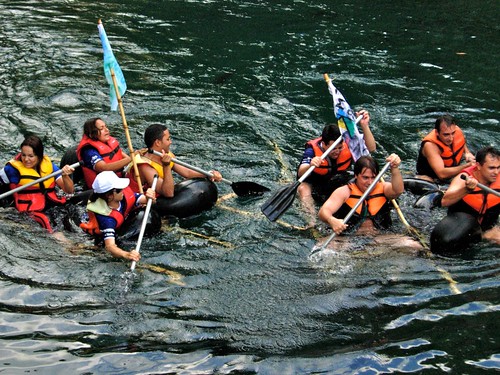
Raucous cheering filled the air which competed with the hum and thrum of the rain forest. Wild toucans flew about the forest canopy while 6 foot long arapaima fish swam below the tangle of arms and legs that were trying to coordinate themselves down the river.
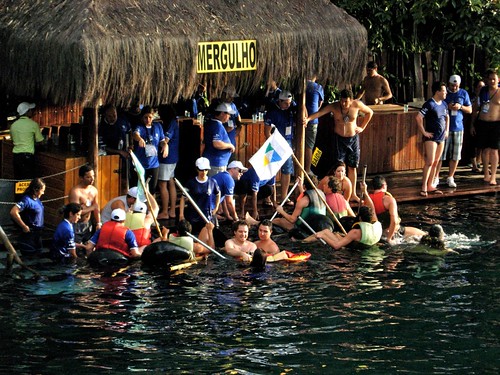
In Rio Quente, Brazil, a thermal river and water playground, I had come across 100 people participating in a Brazilian corporate teambuilding event. I was traveling in Brazil for part vacation and part working at the United Nations World Urban Forum.
From what I could tell, not speaking the language, folks were divided into teams. Each team was given four inner tubes, 6 long pieces of bamboo, rope and a flag. Teams had to build a raft and paddle from one spot to another, whereupon another part of their team would take up the challenge and paddle on to another destination.
There was lots of noise – cheering, yelling, clapping and hollering. No shy retiring folk here. It was hilarious to watch and got me to thinking about teambuilding, Brazilian style. Specifically, I noticed a variety of team personalities:
- some were not in any particular hurry, though it was obviously a race. They took time to smell the jungle flowers so to speak and appeared relaxed and calm
- some were focused on comfort – their rafts had back supports which were formed by folding the inner tubes in half
- some were intent on using only the strongest members of the team. I watched one team paddle under the bridge I was standing on, where only the men were paddling. The women on the team were simply languorously languishing about. I wondered whose plan that was and what the effects were of ignoring half your team.
- some were paddling like hell but not working as a team. I saw one team where an individual didn’t seem to know how to paddle and was actually paddling backwards, negating his teammates efforts. None of his teammates appeared to notice
- other teams had it together and used the best of everyone. Their rhythms were coordinated and, not surprisingly, they booted down the river quite quickly
What I didn’t see was any particularly creative raft making. If their goal was to get from point a to point b as quickly as possible then the most common impediment to that was the drag caused by people’s bodies being vertical in the water.
If it was me I would have encouraged my team to simply lash all the supplies together, hop in water and swim it all down the river. Swimming would have had our bodies more horizontal, allowed for less drag and way more speed.
Now I don’t know if that would have been in the ‘rules’ but that’s what I would have encouraged.
Identifying the boxes we put around our thinking and busting them down is a great gateway to creativity. This often includes circumventing the so called ‘rules’.
And you? What would you have done?
Tags: brazil, collaboration, cooperation, creativity & innovation, learning, rio quente, team, Teambuilding, training & development, united nations, world urban forum
You just never know, surprises Brazilian style
Posted by Lee-Anne Ragan | Filed under Diversity & culture, Travel

As I mentioned in my last post, I’ve been at the UN World Urban Forum (WUF) in Rio de Janiero, Brazil where I gave a workshop on cultural intelligence. Here’s the behind the scenes story to the workshop, what I didn’t tell you in that post.
When the time came to start there were only 3 people in the room. Disappointed, I wondered if the topic was wrong for the conference. I thought perhaps I shouldn’t present it at a WUF conference again.
Then…
The organizers asked if they could let in people. Turns out the participants had been waiting outside the room. The room ended up being at capacity. There were so many people I ran out of handouts.
Then…
A man walked in whose workshop, about social inclusion in cities, I had attended in the morning. I enjoyed his workshop thoroughly and I was equally happy to have him attend my workshop.
Then…
I split from traditional UN genre workshops and did interactive activities that involved a lot of laughter and had people from all over the world working together and enjoying themselves.
Then…
The workshop ended and the same man came up to thank me, saying he’d enjoyed himself and wanted to talk further about possible collaboration.
Then…
I was sorting through the business cards that people left, those who wanted follow-up resource packages and found the unsolicited written feedback pictured above – ‘best two hours in Rio’ (referring to my workshop).
What a kind thing to do, to take the time to give a presenter unasked for feedback. It made my week.
Then…
I realized it was from Gerd Junne, the same man whose workshop I had so admired in the morning. He is the Chair in International Relations at the University of Amsterdam. He’s also the source of the gorgeous woodcut picture in my last post.
You just never know. From disappointment to gaining a new colleague and hosting a sold out workshop all in a small space of time. How fast things can change if only we keep our chins up and our eyes open for 180 degrees of reconsideration.
Tags: brazil, change management, cultural intelligence, gerd junne, rio de janiero, training & development, united nations, world urban forum
Cultural intelligence and the UN Rio World Urban Forum
Posted by Lee-Anne Ragan | Filed under Communication, Conflict resolution, Diversity & culture, Social Responsibility, Travel

Michael Hager, Washburn University, 'Inclusion/Exclusion' woodcut monoprint, 2004
What’s your CQ? You may be familiar with IQ, social intelligence and emotional intelligence but the new kid on the block is cultural intelligence.
I’m in Rio de Janiero, Brazil at the United Nations World Urban Forum. I’ve just finished doing a workshop on cultural intelligence, which is a combination of meta-cognition, skills and knowledge, that allows us to move with and through various cultures, including our own, with confidence and flair even.
Fill in the blanks: ________ are good dancers, _______ are good at math, ________ are bad drivers. Bidden or not, welcome or not, were you able to fill in the spaces? In all likelihood you were. That’s because our brains are wired to fill in the gaps.
The Heath brothers, in Made to Stick, call it the curiousity gap. It’s the same gap that makes us stay up too late watching a TV show we don’t like simply because we want to find out what happens. Who killed who in the whodunnit. This filling in of the gaps is helpful in some areas of life but not intercultural work.
Too often we fill in the gaps wrong while thinking we are right. We tend to assume we know up to 90% more about another culture than we actually do. What can help?
- Have a broad working definition of culture – most of us default to defining culture only by ethnicity. By including gender, faith, material possessions, time, physical space, personal space and many other cultural elements we are more likely to get a richer picture of the people we are working and playing with.
- Check assumptions – look for the boxes that we unwittingly put around our thinking that squeeze our brain into road block thinking.
- Understand your views on conflict – often times working interculturally includes bumping up against conflict. If you understand your own particular view of conflict you’ll have a more effective starting point. For example, do you see conflict as a chance to vent, a way to clear the air, or something that is scary, something to be avoided at all costs?
- Hold a worldview that includes complexity – if you always expect 2 to follow 1, and b to follow a, that is you prefer a linear view of the world you’re likely in for a bumpy ride. On the other hand if, while working interculturally, you expect a complex ride, with ups, downs and hidden corners, you’ll save yourself a lot of stress.
Cultural intelligence is the new kid on the block and a very much welcome one. What will you do to welcome him/her?
Tags: assumptions, brazil, complexity, Conflict resolution, cultural intelligence, culture, heath, intelligence, intercultural, made to stick, united nations, world urban forum, worldview
Bingo based decision making
Posted by Lee-Anne Ragan | Filed under Conflict resolution, Travel

I’m traveling and working in Brazil, for the United Nations, and recently had a curious example of decision making using Bingo.
The tale happens in Rio Quente, a resort anchored around a thermal river. Think every kind of water themed event and you’ll get the picture, including snorkeling with 6 foot long arapaima fish and sliding down a massively steep half pipe on a small inflatable boat.
One balmy evening we decided to go to the 1970’s disco themed show. Before the show, oddly enough, a bingo table was wheeled out. Being game for strange adventures I bought two bingo cards for my kids to play. We sat up very close to the callers, straining our necks to see the board because we didn’t understand the calls in Portuguese.
By some miracle my son won. The equivalent of $65. Sweet!
Fast forward to check out time. Do you think we could find the winning receipt? I emptied packs, looked under the bed, and any other corner I could find with no luck. Our next adventure, the road to Rio was calling and I was getting desperate.
Then we remembered we’d taken a picture of Jeremy with his winning ticket. Voila! A simple cut, paste and enlarge and we had the ticket. I was ecstatic.
Until the desk person wouldn’t accept it. I tried pointing out the ticket number, clearly visible in the photo. He only shook his head. This went on for some minutes.
I was getting more annoyed, frustrated at the apparent brick-walling. No creativity here.
Then I asked for the manager’s name and email.
And then the deluge began. All of a sudden there were many people trying to help. A manager requested I email him the picture. And finally we received our winnings.
So what made the difference? Why was a decision based on what one individual wanted (me) different than when it may have gone public? Did face make the difference, as in not wanting to loose it?
What do yo use as the basis for making a decision? Would you change your decision if more people were involved, if it were a public or a private matter?
Tags: brazil, change management, decision making, decisions, learning, private, public, rio quente, united nations
Christmas in Brazil in March & the road most taken
Posted by Lee-Anne Ragan | Filed under Change management & wellness, Travel

I recently did a marathon. I drove 17 hours, from Rio Quente to Rio de Janeiro, Brazil to present a cultural intelligence workshop at the United Nations World Urban Forum.
When the impossibly white fat and fluffy clouds, which have floated in an endless sea of sky, have given way to an inky darkness great tunes on my IPhone keep me bopping in my seat. At least I think they’re great.
Liam, my son, pronounces them crap. Repeatedly.
Finally a request to listen to the ‘Dave and Morley stuff’ (Stuart McLean’s Vinyl Café podcast) comes in. From Liam.
Liam, the one who is on the cusp of leaving behind childhood and entering teenagehood. Liam, the one who makes my head spin when in one moment, he’s chasing lizards (and dropping them in the pousada pool) and the next is talking about Life, with a capital ‘L’. Big questions. Big curiousity.
He’s at that curious stage where he believes with every fiber of his being that he is forging not just a brand new path but also a completely unique one. He doesn’t yet realize that many have gone before him, he doesn’t see the slightly crushed grass on the trail, the odd branch broken by folks in a hurry, folks who have been here before. Folks who have shunned their parents when peers were anywhere close. And yes, folks who complained bitterly about their parents’ music.
We’ve all sat at the same table, he just doesn’t know it yet.
Around about then he plays a Stuart McLean’s Christmas podcast. Matt Anderson comes on and sings an achingly beautiful rendition of ‘O Holy Night’.
I’m overcome. There in the middle of March, in the middle of Brazil I’m listening to a Christmas song. When Matt sings the well known verse ‘fall on your knees’, a lump as big as a walnut fills my throat.
I’m so grateful for this moment. To be traveling together through this bubble of blackness that our car headlights rhythmically pierce.
When you drive up a steep hill there’s a point where you can’t see where you’re going, where you can’t see beyond the crest of the hill. Your inclination is to put on the brakes but experience tells you to keep going.
The road hasn’t given up its secret, about what’s on the other side of the next hill. The headlights haven’t yet illuminated the unknown. I have to take a leap of faith and trust that the road, the road that many others have traveled before us, will rise up and meet us.
Tags: brazil, Christmas, learning, matt andersen, rio de janeiro, rio quente, stuart mclean, teenage, united nations, vinyl cafe, world urban forum